
The Home Office Deduction: Who Qualifies, How to Calculate It, and What to Keep
A practical guide to the home office deduction: the two qualification tests, the simplified vs. actual method, what evidence the IRS expects, and the entity-specific rules for sole proprietors, partnerships, and S-Corp owners.
15 min readPublished April 29, 2026
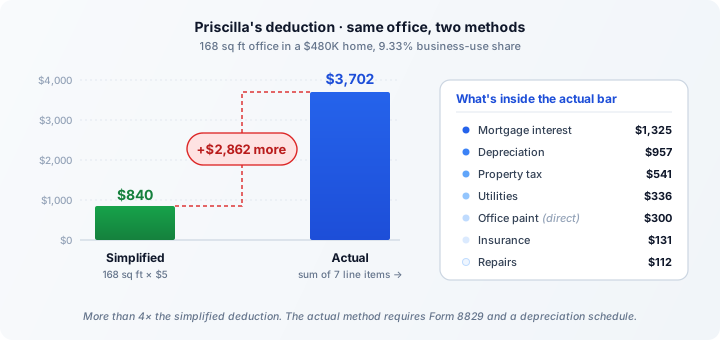
A self-employed designer with a 168 sq ft home office and a $480,000 home leaves more than $3,500 a year of deductions on the table by skipping this deduction. At a typical small-business marginal rate, that's roughly $1,000 to $1,500 of real tax savings every year, which over a decade pays for a couple of nice vacations or a substantial chunk of a kitchen remodel. Most people skip it because of a rumor that started in the 1990s: that claiming a home office is an audit flag. The rule changed in 1999. The rumor didn't.
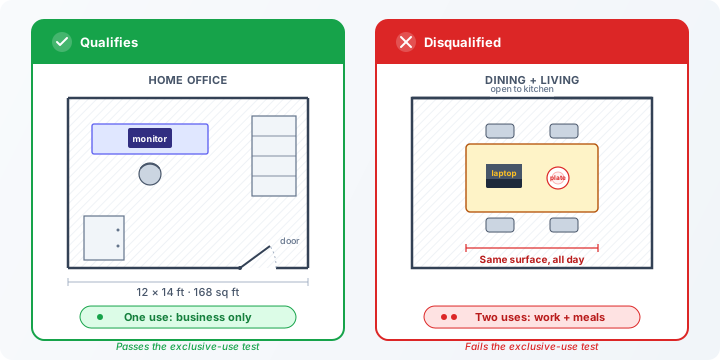
The other half of the people who try to take it disqualify themselves on day one by failing the exclusive-use test. They put a laptop on the kitchen counter and call it a deduction. The IRS does not.
This guide is the antidote to both mistakes. Four questions to confirm you qualify, two methods to calculate it, the evidence to keep, and the entity-specific path for your business structure. By the end, you'll know whether you qualify, what to claim, and how to defend it if asked.
At a glance
- Two tests qualify the space: regular and exclusive business use, in your principal place of business
- Two methods to calculate: simplified ($5/sq ft, capped at $1,500) or actual (real expenses × business-use %)
- Your entity routes the deduction: Schedule C for sole props, UPE for partners, accountable plan for S-Corps
- W-2 employees can't deduct federally (permanent under OBBBA, 2025); a few states still allow it
- Keep: floor plan, photos, expense records, depreciation schedule (if actual)
Step 1: Do you actually qualify?
Before you calculate anything, run through the four-question gate. All four answers have to be yes.
Question 1: Are you self-employed, a partner, or a corporate owner?
If you're a W-2 employee receiving a paycheck (including from your own S-Corp), you cannot deduct home office expenses on your federal return. The Tax Cuts and Jobs Act suspended the deduction for unreimbursed employee business expenses starting in 2018, and the One Big Beautiful Bill Act (OBBBA), signed in July 2025, made that suspension permanent. There is no scheduled return date.
If you're self-employed (sole proprietor, single-member LLC, independent contractor, freelancer), you qualify to deduct directly on Schedule C.
If you're a partner in a partnership or multi-member LLC, you can deduct as an unreimbursed partnership expense (UPE), provided your partnership agreement requires you to pay the expense without reimbursement.
If you're an S-Corp or C-Corp owner, you don't deduct directly. You set up an accountable plan and have the corporation reimburse you for the business-use portion of your home office expenses. The reimbursement is tax-free to you and deductible by the corporation, which is functionally equivalent to a deduction.
Question 2: Is the space used regularly and exclusively for business?
This is the test that disqualifies the most people. Read it carefully.
- Regularly means consistent, ongoing use. Occasional or sporadic use doesn't qualify. A desk you sit at three days a week is fine; a card table you set up at tax time is not.
- Exclusively means only for business. No personal use whatsoever, ever.
The exclusive-use test is binary and unforgiving. A guest bedroom that doubles as your office on weekdays fails. A dining room table where you work in the morning and eat dinner at night fails. The space doesn't need a door, but it needs an unambiguous identity. A partitioned section of a basement, a corner of a room marked off by bookshelves, or a converted garage all pass; the test is whether the space's only function is your business.
Note: Two narrow exceptions exist: (1) running an in-home daycare licensed under state law, where personal use of the space outside daycare hours is allowed, and (2) storing inventory or product samples in your principal place of business, where the storage area can be used incidentally for personal things. The daycare exception comes with its own math (you allocate by time and area on Form 8829 Part III, not by area alone), so don't naively apply the simplified method if you're running a daycare. For everyone else, exclusive means exclusive.
Question 3: Is the space your principal place of business?
You meet this test if any of the following is true:
- It's your main place of business: you do substantially all your administrative or management work there (billing, scheduling, recordkeeping, ordering supplies), and you have no other fixed location where you do those things
- You meet clients, customers, or patients there in the normal course of your business
- It's a separate structure (a detached studio, garage office, ADU) used in connection with your business
Most freelancers, consultants, and small business owners qualify under the first prong: even if you sometimes work at a client's site or a coffee shop, the place where you do your administrative work is your principal place of business. The 1993 Soliman case narrowed this rule, but Congress restored the administrative-and-management prong in the Taxpayer Relief Act of 1997, effective for tax years beginning in 1999.
Question 4: Will the deduction actually save you money?
The home office deduction is limited to your business income. You can't use it to create or deepen a loss. If your Schedule C is already showing a small profit, the simplified method ($1,500 max) might wipe it out completely, leaving nothing to deduct. The unused portion of the actual-method deduction can be carried forward to future years; the simplified method's unused portion cannot.
If your business is in its first year and barely profitable, the simplified method is often the better choice anyway: less paperwork, no depreciation, no recapture when you sell.
Step 2: Pick a method
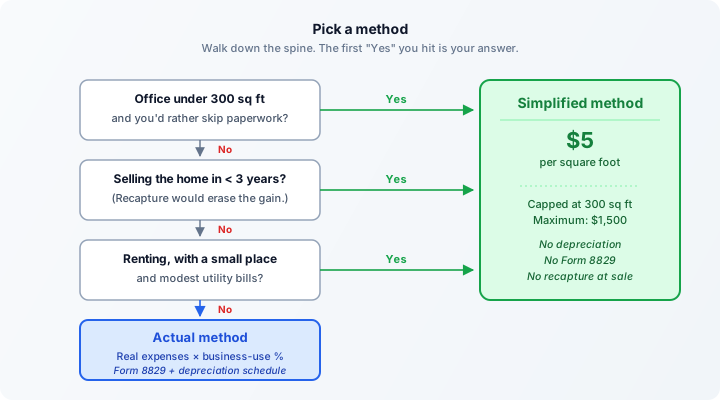
Two methods exist. You can switch between them year to year, but you can't combine them in the same year.
The simplified method
- Rate: $5 per square foot of qualifying home office space
- Cap: 300 square feet (so the maximum deduction is $1,500)
- What it covers: all home-office-related expenses, in one number
- What you don't do: no depreciation, no allocation of utilities or mortgage interest, no Form 8829
- Where it goes: directly on Schedule C, line 30
- Recapture: none. When you sell the home, no portion of the gain is taxed as depreciation recapture from this method
The simplified method is the right choice when:
- Your office is small (under ~300 sq ft) or your home expenses are modest
- You don't want the recordkeeping burden of the actual method
- You plan to sell the home in the next few years and want to avoid depreciation recapture
- You want the deduction to be obviously defensible without a ream of documentation
The actual method
- Rate: business-use percentage × actual home expenses
- Business-use %: office square footage ÷ total home square footage. (Some taxpayers use a room-count method when rooms are roughly equal in size, but square footage is the safer default.)
- What it covers: utilities, homeowners insurance, mortgage interest (or rent), property taxes, repairs and maintenance, depreciation on the business-use portion
- Where it goes: Form 8829, then to Schedule C
- Recapture: yes. The depreciation you claim each year reduces your home's adjusted basis. When you sell, that depreciation is "recaptured" and taxed at up to 25% (Section 1250), even if the rest of the gain is excluded under the home-sale exclusion
Two categories of expenses inside the actual method:
- Direct expenses (100% deductible): costs that benefit only the office, like painting just the office, a dedicated business phone line, repairs limited to the office space
- Indirect expenses (business-use % deductible): costs that benefit the whole home, like utilities, insurance, mortgage interest, depreciation, security system
A note for renters
Renters can absolutely take the actual method, and the calculation is easier than for owners. Your "indirect expenses" line for housing is just rent × business-use %, with utilities and renter's insurance handled the same way. There's no depreciation step (you don't own the asset), which means there's no recapture to worry about when you eventually move out. For a renter with a small office and modest utilities, the simplified method often still wins on paperwork-to-deduction ratio, but don't self-disqualify imagining the actual method requires owning a home.
Which to pick: a simple comparison
Run both calculations the first year. Most owners do the math once and find their answer is stable for several years.
| Your situation | Likely better method |
|---|---|
| Office under 300 sq ft, modest home expenses | Simplified |
| Renting (no depreciation to take), small home | Simplified |
| Owning, large home, large office, high utility/mortgage costs | Actual |
| You expect to sell the home within ~3 years | Simplified (avoids recapture) |
| First year of business, low profit | Simplified |
| Established business, tight bookkeeping habit | Actual (almost always larger) |
Step 3: Calculate it (worked example)
Meet Priscilla, a freelance UX designer who works full-time from home. She has a single-member LLC reporting on Schedule C. Her home is 1,800 sq ft total. She converted a 12 × 14 spare bedroom (168 sq ft) into a dedicated office. She uses the room only for client work; the door stays closed when she's not working.
Business-use percentage: 168 ÷ 1,800 = 9.33%
Simplified method
168 sq ft × $5 = $840
That's it. $840 deduction, on Schedule C line 30. No further math, no Form 8829.
Actual method
Her annual home expenses:
| Expense | Total | Business-use % | Deductible |
|---|---|---|---|
| Mortgage interest | $14,200 | 9.33% | $1,325 |
| Property tax | $5,800 | 9.33% | $541 |
| Homeowners insurance | $1,400 | 9.33% | $131 |
| Utilities (electric, gas, water) | $3,600 | 9.33% | $336 |
| Repairs and maintenance (whole-home) | $1,200 | 9.33% | $112 |
| Office painting (direct) | $300 | 100% | $300 |
| Depreciation (see below) | n/a | n/a | $957 |
| Total | $3,702 |
Depreciation on the actual method: take the lesser of your home's adjusted basis or fair market value (excluding land), multiply by the business-use percentage, and depreciate it as nonresidential real property over 39 years.
Priscilla's home cost $480,000, with land assessed at $80,000. So $400,000 is the depreciable basis. Her business-use share: $400,000 × 9.33% = $37,320. Annual depreciation (full year): $37,320 ÷ 39 ≈ $957. (In the year she first uses the office, she'd actually use the IRS's first-year MACRS table from Pub. 946 with a mid-month convention, which produces a smaller figure depending on the start month. After year one, $957 is the steady-state.) The actual-method deduction is also limited to her business income; any excess carries forward.
Result: Priscilla's actual-method deduction is roughly $3,702 vs. $840 simplified, more than 4× larger. She picks actual. She'll keep the depreciation schedule in her records and remember that when she sells the home, the depreciation she claimed will face recapture.
Step 4: Document the space (the evidence file)
Whether you pick simplified or actual, build a single folder (digital or physical) that proves the office exists and is used the way you say it is. You'll thank yourself if you ever face questions.
Always:
- A simple floor plan of your home with the office area marked, including dimensions
- The arithmetic for your business-use percentage (square footage of office, square footage of home)
- 3–5 photos of the office showing dedicated business use (desk, equipment, no bed, no toys, no exercise bike)
- Calendar entries, video call records, or a brief log establishing regular use across the year
Actual method, additionally:
- Utility bills, mortgage statements (showing the interest portion), property tax bills, insurance declarations
- Depreciation schedule (your accountant or software produces this) with the home's basis, business-use percentage, and accumulated depreciation
- Receipts for any direct expenses (painting the office, business phone line, office-only repairs)
- Form 8829 itself, filed with your return each year
Keep records for at least 3 years after the return's due date (the standard IRS audit window). If you took depreciation, keep the depreciation schedule for the life of the property plus 3 years, because the depreciation recapture math at sale depends on it.
Step 5: File it correctly for your entity
Sole proprietor / single-member LLC
- Simplified method: enter the deduction directly on Schedule C, line 30
- Actual method: complete Form 8829, then carry the result to Schedule C, line 30
- The deduction reduces both income tax and self-employment tax
Partnership / multi-member LLC
- The partnership agreement should state that partners are required to pay home office expenses without reimbursement (this is the threshold for UPE)
- The partner deducts the home office expense on Schedule E, Part II, on a separate line labeled "UPE" (unreimbursed partnership expense), reducing their share of partnership income
- Form 8829 is not used in this path; you compute the same numbers manually but report them on Schedule E
- Alternatively, the partnership can reimburse the partner under an accountable plan, which is cleaner
S-Corp or C-Corp owner
- You cannot deduct on your personal return. The TCJA closed that door in 2018
- Set up an accountable plan at the corporate level
- Each month, submit an expense report to the corporation listing the business-use percentage of utilities, mortgage interest, property tax, insurance, and (if you elect) a reasonable rent or depreciation equivalent
- The corporation reimburses you. The reimbursement is not wages, not on your W-2, and is fully deductible to the corporation
- This is the cleanest, most defensible path for owner-employees, and it's the only one that produces a real deduction in the corporate context
Note: If you operate as an S-Corp and you've been ignoring the home office benefit because you thought you couldn't deduct it, you've probably been leaving four-figure annual savings on the table. The setup work is one accountable plan policy and a monthly expense report. Done once, the rhythm is automatic.
State tax: don't assume federal answers travel
Most states piggyback on federal Schedule C, so the deduction flows through automatically for the self-employed. But state treatment diverges in two situations worth flagging:
- W-2 employees: California, New York, Pennsylvania, Alabama, Arkansas, Hawaii, and Minnesota still allow some version of the unreimbursed employee expense deduction at the state level, even though federal blocks it. If you're an employee in one of those states with an unreimbursed home office, check your state instructions.
- States with no income tax (TX, FL, WA, etc.): the federal calculation is the only one that matters for you, but if you split residency or earn income in another state, that state's rules can apply.
- Depreciation conformity: a few states use different depreciation rules than federal MACRS (most notably California's older, slower schedule for property placed in service before certain dates). If you're using the actual method and taking depreciation, ask your CPA whether your state's depreciation schedule matches.
Common mistakes that get the deduction disallowed
- Claiming a non-exclusive space. A guest room, dining table, or living-room couch will not survive the exclusive-use test
- Including land value in depreciation. Land doesn't depreciate. Subtract the land assessment from the purchase price before applying the business-use percentage
- Using a business-use percentage that doesn't match the floor plan. "I work in the whole upstairs" without measurements invites trouble. Use square footage, write it down, defend it
- Forgetting depreciation recapture. If you take depreciation under the actual method, plan for the recapture tax when you sell. The home-sale exclusion (up to $250K/$500K) doesn't shield depreciation recapture
- Switching back and forth carelessly. You can switch between simplified and actual year to year, but switching mid-year (or claiming both methods for different parts of the same year for the same office) isn't allowed
- Claiming it as a W-2 employee. Federal: permanently not allowed (TCJA 2018, made permanent by OBBBA 2025). A few states still permit it, so check your state instructions
Quick-decision checklist
Before you file, run through this. If you can answer yes to all of them, you're on solid ground.
- I'm self-employed, a partner, or an S-Corp owner using an accountable plan (not a W-2 employee)
- My office is a clearly defined area, used only for business, regularly across the year
- I do my administrative or management work primarily from this space (or it's where I meet clients, or it's a separate structure)
- I have measured the office and the home, and I have a floor plan in my records
- I have at least 3 photos showing the space in business use
- If using the actual method: I have utility, mortgage, property tax, and insurance records for the year, and a depreciation schedule
- My deduction does not exceed my business income (or I'm prepared to carry the excess forward)
- For S-Corp owners: my accountable plan is in writing, and I have monthly expense reports
References
- IRS Publication 587: Business Use of Your Home: the canonical rules and worked examples
- Form 8829: Expenses for Business Use of Your Home: the form sole props use for the actual method
- Schedule C: Profit or Loss from Business: where the deduction lands for self-employed taxpayers
- Revenue Procedure 2013-13: the simplified method
- Commissioner v. Soliman, 506 U.S. 168 (1993): the case that briefly narrowed "principal place of business"
- Taxpayer Relief Act of 1997: amended Section 280A to restore the administrative-and-management prong (effective for tax years beginning in 1999)
- One Big Beautiful Bill Act of 2025 (OBBBA): made the TCJA suspension of unreimbursed employee business expense deductions (including W-2 home offices) permanent
Key takeaway
The home office deduction is straightforward once you internalize three things. First, the qualifying gate is exclusive and regular use, not the size or appearance of the space. Second, the simplified method is for people whose office is small or whose tolerance for bookkeeping is low; the actual method is for people who'll do the work and want the larger number. Third, your entity dictates the path: sole props deduct directly, partners use UPE, and corporate owners reimburse themselves through an accountable plan.
Document the space once, decide on a method, and the deduction becomes a routine line item that's worth real money every year.
Related
- Accountable plans: the mechanism S-Corp and C-Corp owners use to reimburse themselves tax-free for home office costs
- The Augusta Rule: the related strategy for renting your home to your business up to 14 days a year
- Chart of accounts setup: where to record reimbursements and home office expenses in your books
- Reading financial statements: how the deduction shows up on your P&L
Disclaimer
This guide explains the federal home office deduction at a high level. It is not tax, legal, or financial advice. Eligibility, calculation methods, depreciation rules, recapture, and state treatment vary by jurisdiction and individual circumstance. Tax laws change; in particular, the One Big Beautiful Bill Act (OBBBA, July 2025) made the W-2 employee deduction suspension permanent; that's the law as of this guide's last update. Consult your CPA or tax advisor for guidance specific to your situation.
Try it in Twin Owls
See this in action in the app. Open in app