Single Entry vs. Double Entry Accounting
Single entry vs double entry bookkeeping — how each system works, where single entry breaks down, and which method your business actually needs.
Published February 15, 2026 · Updated April 12, 2026
Checking your bank balance tells you how much cash you have. It does not tell you whether your books are right. That is the difference between single entry and double entry bookkeeping — one tracks cash, the other tracks reality. One is simple enough to run in a notebook. The other is the globally accepted standard that has underpinned commerce since the 15th century.
What is single entry accounting?
Single entry accounting records each transaction once — as either income or an expense. Think of it as a financial diary: money comes in, you write it down; money goes out, you write that down too. There are no debits, no credits, no balancing acts.
How it works
A single entry system typically lives in a cashbook or basic spreadsheet. Each row captures a date, a description, and either an income amount or an expense amount. At the end of a period, you tally the columns and arrive at your net cash position.
Say you run a small landscaping LLC. On March 1, a client pays you $2,000. You log it as income. On March 5, you buy $300 of supplies. You log it as an expense. Net: +$1,700. That's the whole system.
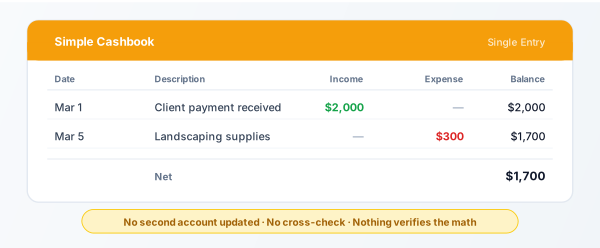
Single entry is simple to learn, fast to record, and costs nothing beyond a spreadsheet. For a sole trader with a handful of transactions per month, it genuinely works. But it has real limits:
- No error detection — a wrong number just lives there, unchallenged. If you accidentally type $200 instead of $2,000, nothing in the system flags it. The mistake carries forward silently.
- No balance sheet — you can see cash in and cash out, but assets and liabilities are invisible. You have no picture of what the business owns or owes.
- No audit trail — entries don't cross-reference each other, so there is nothing for an auditor to verify against.
- Not accepted for compliance — most jurisdictions will not accept single entry books for GAAP or IFRS reporting.
Single entry is a flashlight in a dark room: you can see what is directly in front of you, but you have no idea what the rest of the room looks like.
What is double entry accounting?
Double entry accounting is the global standard, and it earned that status. In 1494, a Franciscan friar named Luca Pacioli published Summa de Arithmetica, a mathematics textbook that included a now-famous chapter on double-entry bookkeeping. His insight was simple: every transaction tells two stories, and you need to record both. Five centuries later, every major accounting standard in the world still agrees with him.
The core rule: every transaction affects at least two accounts, and the total debits must always equal the total credits. The books must balance. Always. This is not bureaucratic fussiness — it is a built-in lie detector.
The accounting equation
Assets = Liabilities + Equity
Every double entry transaction keeps this equation in balance. Buy equipment with a loan? Assets go up, liabilities go up — both sides stay equal. The math never lies, which is precisely the point. For a deeper dive into the equation and what each term means, see Accounting basics.
The same transaction, double entry style
Take the same landscaping example. Your client pays $2,000. In double entry, that is two things happening at once: your bank account (an asset) goes up by $2,000, and your revenue goes up by $2,000. Both sides are recorded in a single journal entry.
Now the $300 supply purchase. Your expense goes up and your bank account goes down — again, two sides of the same event. Same pattern, same balance.
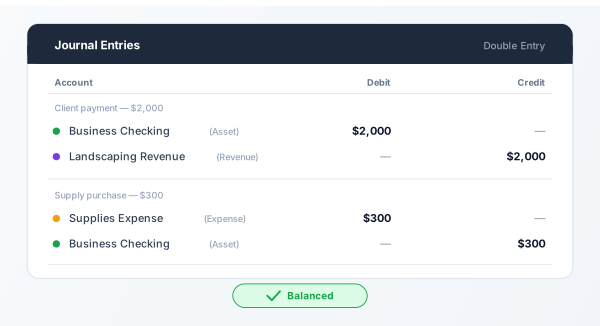
The result: you know your cash position ($1,700), just like single entry — but you also know your total revenue, your expense breakdown, and the fact that every number cross-checks against another. Where single entry gives you a flashlight, double entry turns the lights on in the whole room.
Why errors can't hide
Remember the accidental $200-instead-of-$2,000 typo from the single entry section? In double entry, that mistake can't slip through quietly. If you record a $200 debit to Business Checking but the client actually paid $2,000 and the credit to Landscaping Revenue is $2,000, the entry won't balance — $200 does not equal $2,000. The system stops you before the error reaches your books. In single entry, that wrong number just lives in the cashbook forever.
Debits and credits
Each journal entry has at least one debit and one credit. These are not "good" and "bad" — they are directions. Now that you have seen the pattern in the examples above, here is the general rule:
- Debits increase asset and expense accounts; credits decrease them
- Credits increase liability, equity, and revenue accounts; debits decrease them
In the landscaping payment, the debit to Business Checking (an asset) increased it, and the credit to Landscaping Revenue increased that too — because revenue accounts grow on the credit side. The logic is consistent once you map it to the examples.
Double-entry bookkeeping produces complete financial statements — income statement, balance sheet, and cash flow statement. It is required for GAAP and IFRS compliance. The trade-off is a steeper learning curve and more time per transaction, which is why most businesses use accounting software to handle the mechanics.
Side-by-side comparison
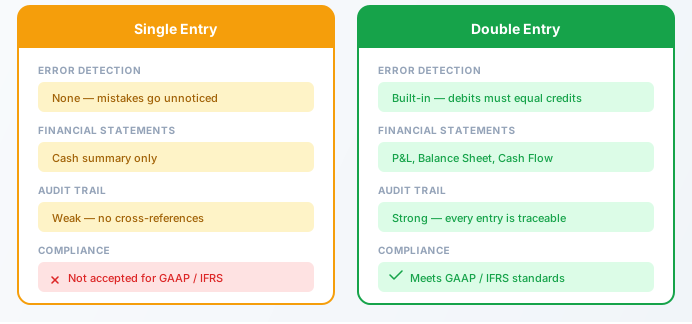
Here is how the two approaches stack up across the four dimensions that matter most: error detection, financial statements, audit trail, and compliance.
Which system should you use?
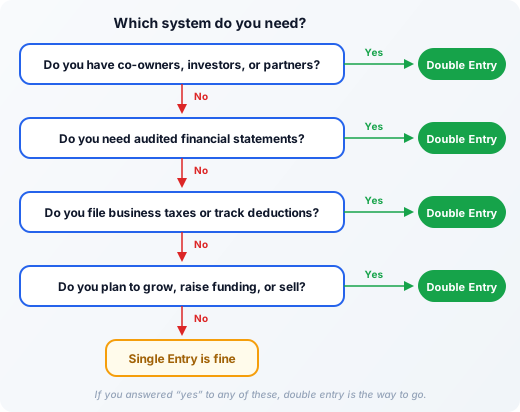
If you are a freelancer with a handful of transactions per month and no co-owners, single entry is probably fine for now. Beyond that, use double entry. Ask yourself four questions:
- Do you have co-owners, investors, or partners?
- Do you need audited financial statements?
- Do you file business taxes or need to track deductible expenses accurately?
- Do you plan to grow, raise funding, or sell?
If you answered "yes" to any of those, double entry is the right choice.
Note: Single entry tells you what happened to your cash. Double entry tells you what is actually going on. For most businesses beyond the freelance stage, only double entry is enough.
How Twin Owls handles this
You do not need to think in debits and credits. Twin Owls uses double entry under the hood, but you interact with it by describing what happened — and it writes the balanced journal entry for you. Record that $2,000 client payment, and Twin Owls produces the same Business Checking / Landscaping Revenue entry shown above, automatically.
Twin Owls also enforces balance before you can save. If total debits do not equal total credits, the save button stays disabled. Your books are correct by construction, not by hope.
If you manage multiple entities — a rental property LLC, a holding company, a personal portfolio — each gets its own isolated ledger with its own chart of accounts and reports. You switch between them from the sidebar without logging in and out. The double entry foundation stays consistent across all of them.
For details on how journal entries work in the app, see Double-entry bookkeeping and journal entries.
Key takeaway
Double entry is more demanding than single entry — but it rewards that demand with error detection, complete financial statements, and a clear picture of what your business actually owns, owes, and earns. For any business with co-owners, investors, or growth ambitions, it is not a choice; it is the foundation.
This article is intended for informational purposes only and does not constitute financial or accounting advice. Consult a qualified accountant or CPA for guidance specific to your situation.
Try it in Twin Owls
See this in action in the app. Open in app