Accounting Basics: What Every Business Owner Needs to Know
Understand the one rule behind all bookkeeping — the accounting equation — and why it matters for your business.
Published January 20, 2026 · Updated April 7, 2026
If you own a business — even a single rental property — you're doing accounting whether you realize it or not. Every time you collect rent, pay a contractor, or transfer money between accounts, you're creating a financial event that needs to be recorded. Accounting is just the system for doing that consistently so you always know where your money is and where it went.
This guide covers the single most important idea in accounting: the accounting equation. Once you understand it, everything else — journal entries, financial reports, chart of accounts — follows naturally.
The accounting equation
All of accounting rests on one rule:
Assets = Liabilities + Equity
That's it. Every transaction your business ever records must keep this equation in balance. If the left side goes up, the right side goes up by the same amount. If you understand this, you understand the foundation of double-entry bookkeeping.
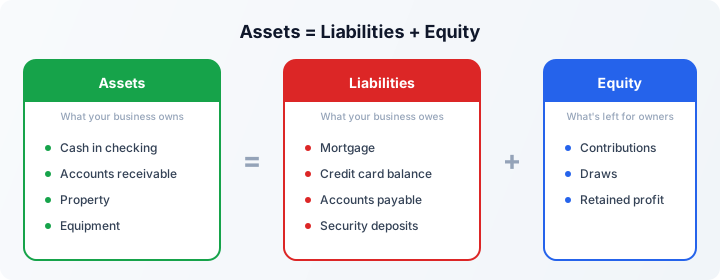
Let's break down what each term means.
Assets: what your business owns
Assets are things of value that your business controls. If it puts money in your pocket or could be converted to cash, it's probably an asset.
- Cash in your checking account — the most obvious asset
- Accounts receivable — money a tenant owes you but hasn't paid yet
- Property — a rental building you own through your LLC
- Equipment — tools, appliances, or vehicles used for the business
When your tenant pays rent and you deposit $1,500 into your business checking account, your assets just went up by $1,500.
Liabilities: what your business owes
Liabilities are debts and obligations — money your business owes to someone else.
- Mortgage — the loan balance on a rental property
- Credit card balance — charges you haven't paid off yet
- Accounts payable — a contractor invoice you received but haven't paid
- Security deposits held — money a tenant gave you that you'll return later
When you charge $200 on your business credit card for supplies, your liabilities went up by $200 (you now owe the card company more).
Equity: what's left for the owners
Equity is the difference between what you own and what you owe. It represents the owner's stake in the business.
Equity = Assets - Liabilities
If your LLC has $50,000 in assets and $30,000 in liabilities, the owners' equity is $20,000. That's the book value of the business.
Equity changes when:
- Owners contribute money — you deposit personal funds into the business (equity goes up)
- Owners take draws — you transfer business money to yourself (equity goes down)
- The business earns profit — revenue minus expenses flows into equity at year-end
Why the equation always balances
Every financial event affects at least two things. That's the core idea behind double-entry bookkeeping — and it's why your books either balance or they don't. There's no middle ground.
Here are three examples:
You collect $1,500 in rent. Your bank account (asset) goes up by $1,500. Your rental revenue goes up by $1,500, which increases equity. Assets went up, equity went up — the equation balances.
You pay a $200 repair bill with your credit card. Your repair expense goes up by $200 (which decreases equity). Your credit card balance (liability) goes up by $200. Equity went down, liabilities went up — still balanced.
You pay off $500 of your credit card from checking. Your bank account (asset) goes down by $500. Your credit card balance (liability) goes down by $500. Both sides decreased equally — balanced.
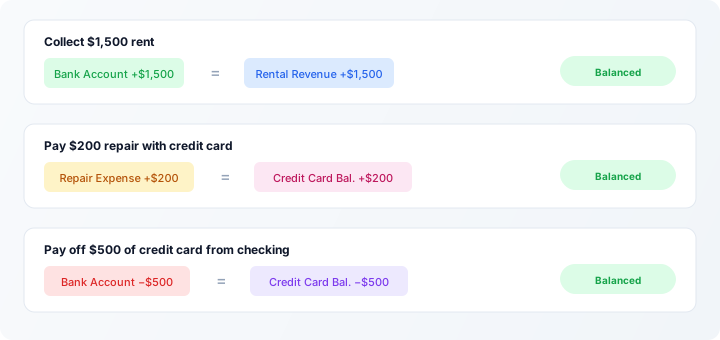
If you can follow these three examples, you already understand how bookkeeping works. The rest is just applying this pattern consistently.
How Twin Owls is organized around this
Twin Owls structures everything around these concepts:
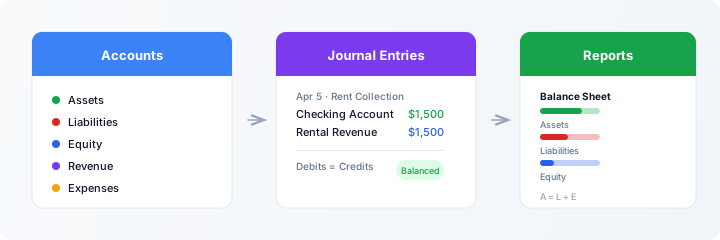
- Accounts are grouped by type — Assets, Liabilities, Equity, Revenue, and Expenses. Revenue and Expenses are subcategories that feed into Equity through profit and loss.
- Journal entries are how you record transactions. Each entry has at least two lines that keep the equation balanced — Twin Owls enforces this before you can save.
- Reports show you the result — the Balance Sheet is literally the accounting equation laid out as a report: assets on one side, liabilities and equity on the other.
Key takeaway
Every transaction your business records must keep the accounting equation balanced: Assets = Liabilities + Equity. If you understand that one rule, you understand the foundation of all bookkeeping. Everything in Twin Owls — accounts, journal entries, and reports — is built around enforcing it.
Try it in Twin Owls
See this in action in the app. Open in app