
Rental Property Bookkeeping: A Complete Guide for Landlords
How to set up your books for a rental property LLC, record rent and expenses, handle security deposits, distinguish repairs from capital improvements, and run month-end reports, with step-by-step journal entries in Twin Owls.
11 min readPublished April 20, 2026 · Updated April 26, 2026
Every rental property owner is doing bookkeeping. Most are just doing it badly. Rent deposits land in a personal checking account, repairs get paid on a credit card that mixes personal and business charges, and at tax time the CPA gets a shoebox of receipts and a best guess. The result: missed deductions, overpaid taxes, and no way to answer the basic question: is this property actually making money?
It doesn't have to be that way. A clean set of books takes about 30 minutes a month once it's set up. This guide walks you through the full setup and your first month of bookkeeping for a rental property LLC using Twin Owls. We'll follow Marco Reyes and his duplex (every rent payment, every repair bill, every mortgage check), and turn each event into a journal entry. By the end, you'll see how those entries roll up into reports that tell you exactly how the property performed.
At a glance
- Your LLC gets its own ledger in Twin Owls with rental-specific accounts
- Rent collected is revenue; security deposits are liabilities, not income
- Repairs are deductible immediately; capital improvements must be depreciated
- Residential rental depreciation = building cost ÷ 27.5 years (straight-line)
- Monthly rhythm: record income → record expenses → review reports
Meet Marco: one LLC, one duplex
Marco Reyes owns Reyes Property LLC, a single-member LLC that holds a duplex at 742 Elm Street in Austin. The two units:
- Unit A: tenant Diana Solis, rent $1,650/month
- Unit B: tenant Jason Park, rent $1,550/month
Marco bought the duplex two years ago, but he's been tracking everything in a spreadsheet. He just set up Twin Owls and wants to get his books right going forward. We'll follow him through April 2026, from setting up his chart of accounts to pulling his month-end profit-and-loss report.
Setting up your chart of accounts
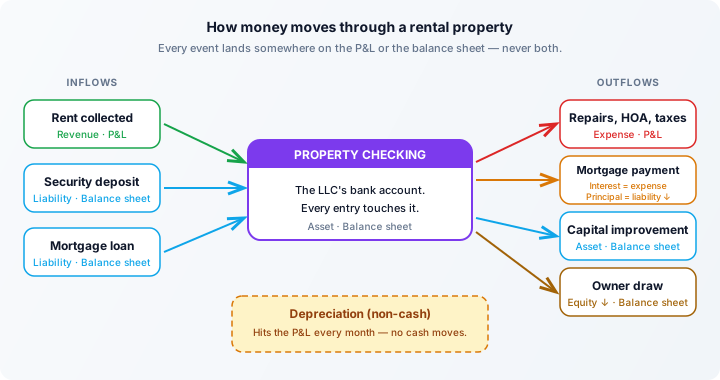
When you create a business in Twin Owls, you start with 39 default accounts across the five types (assets, liabilities, equity, revenue, expenses). For a rental property, you'll add accounts that match how money actually moves through the property. Here's what Marco adds, in the order you'll want to set them up:
Start with these. You'll use them every month:
| Code | Account Name | Type | Why you need it |
|---|---|---|---|
| 10200 | Property Checking | Asset | Your LLC's bank account; every entry touches this |
| 40100 | Rental Income | Revenue | Where rent goes |
| 63500 | Maintenance and Repairs | Expense | Plumbing, appliances, patches; the most common landlord expense |
| 64000 | Mortgage Interest | Expense | The deductible portion of your mortgage payment |
| 20100 | Mortgage Payable | Liability | Tracks your remaining loan balance |
Add these as they come up:
| Code | Account Name | Type | When you'll need it |
|---|---|---|---|
| 62600 | HOA Fees | Expense | If your property has an HOA |
| 62500 | Property Management Fees | Expense | If you use a property manager |
| 66800 | Property Tax | Expense | When you pay property tax (often semi-annually) |
| 22000 | Security Deposits Held | Liability | When you collect a deposit from a tenant |
| 16000 | Capital Improvements | Asset | When you pay for a major improvement (roof, HVAC, remodel) |
Set up once. Your CPA will help with the numbers:
| Code | Account Name | Type | Purpose |
|---|---|---|---|
| 15000 | Rental Property | Asset | The building's original cost (not land) |
| 15100 | Accumulated Depreciation | Asset (contra) | Tracks total depreciation taken to date; reduces the property's book value |
| 76500 | Depreciation Expense | Expense | Monthly depreciation charge |
Open Accounts from the sidebar, click Add account, and fill in the code, name, and type. The account codes determine where each line appears on your reports. All the details are in the chart of accounts guide.
Recording opening balances
If you're starting Twin Owls mid-life on a property you already own (like Marco), you need one journal entry to bring your existing balances onto the books. Without this, your balance sheet starts at zero and your reports won't reflect reality.
Marco bought the duplex for $225,000 two years ago with a 20% down payment, financing $180,000. The land is worth $50,000, so the building (depreciable basis) is $175,000. After two years of monthly mortgage payments, his loan balance is $176,400. He has $14,200 in the LLC checking account and holds $1,550 in security deposits from Jason (Unit B). His CPA tells him he's taken $12,727 in accumulated depreciation so far.
He records one opening-balance entry dated April 1 (his start date in Twin Owls):
| Account | Debit | Credit |
|---|---|---|
| Property Checking | $14,200 | |
| Rental Property | $175,000 | |
| Member Equity | $1,477 | |
| Mortgage Payable | $176,400 | |
| Security Deposits Held | $1,550 | |
| Accumulated Depreciation | $12,727 | |
| Totals | $190,677 | $190,677 |
Description: "Opening balances, Reyes Property LLC, as of April 1, 2026"
A few things to notice:
- Rental Property is the building value only ($175,000), not the full purchase price. Land isn't depreciable and most landlords don't track it as a separate account.
- Accumulated Depreciation captures everything already taken in prior years. Your CPA or prior tax returns will have this number.
- Member Equity is the plug: whatever makes debits equal credits. In Marco's case it lands as a small debit ($1,477), meaning his book equity is slightly negative. That is normal and expected for a buy-and-hold rental in its early years: depreciation has chipped away at the building's book value while the mortgage hasn't paid down enough to offset it. The duplex's market value has likely appreciated, but book equity reflects original cost basis less accumulated depreciation, not market value. If you're not sure about any of the other numbers, your CPA can pull them from your last tax return (Schedule E and the depreciation worksheet).
- Security Deposits Held includes any deposits you're currently holding from tenants.
Note: Your opening-balance entry only needs to be approximate to be useful. A balance sheet that's 95% right is infinitely better than no balance sheet at all. You can always post an adjusting entry later when your CPA confirms the exact numbers.
Once this entry is posted, your balance sheet reflects the real state of the property, and every transaction going forward builds on it.
Recording rent collection
On April 1, Diana deposits $1,650 for Unit A. Marco opens Transactions, clicks Add journal entry (or presses n), and records:
| Account | Debit | Credit |
|---|---|---|
| Property Checking | $1,650 | |
| Rental Income | $1,650 |
Description: "April rent, Unit A, 742 Elm St (Diana Solis)"
Jason pays late, on April 8. Same pattern, different amount and date:
| Account | Debit | Credit |
|---|---|---|
| Property Checking | $1,550 | |
| Rental Income | $1,550 |
Description: "April rent, Unit B, 742 Elm St (Jason Park)"
Two things to note: first, make your descriptions specific enough that you'll recognize them months later. "Rent" alone won't cut it when you have multiple units. The journal entries guide covers this in detail. Second, since rent entries repeat every month, save them as templates so next month is a single click.
Note: If your tenants pay into a connected bank account, Twin Owls creates the transaction automatically from the bank feed. You just categorize it as Rental Income.
Security deposits: a liability, not income
Mid-April, Marco signs a new tenant for Unit B starting May 1. The tenant sends a $1,550 security deposit on April 20. This is the most common mistake in rental bookkeeping: a security deposit is not revenue. It's money you hold on behalf of the tenant and owe back when they move out (minus any legitimate deductions). It's a liability.
| Account | Debit | Credit |
|---|---|---|
| Property Checking | $1,550 | |
| Security Deposits Held | $1,550 |
When the tenant eventually moves out and you return the full deposit, you reverse it:
| Account | Debit | Credit |
|---|---|---|
| Security Deposits Held | $1,550 | |
| Property Checking | $1,550 |
If you withhold $350 for cleaning and damage repair, the entry splits:
| Account | Debit | Credit |
|---|---|---|
| Security Deposits Held | $1,550 | |
| Maintenance and Repairs | $350 | |
| Property Checking | $1,200 |
Here's what's happening line by line: the full $1,550 liability is cleared (debit removes it from what you owe). Of that, $350 offsets the cost of the repair; it's credited to Maintenance and Repairs because the tenant is effectively paying for the damage, not the LLC. The remaining $1,200 goes back to the tenant as cash out of your checking account. The net effect: the liability is gone, you returned most of the money, and the repair cost didn't hit your expenses because the tenant covered it.
Note: Many states require landlords to hold security deposits in a separate bank account. Check your state's landlord-tenant laws. If required, create a dedicated "Security Deposit Trust" account in your chart of accounts and record the deposit there instead of Property Checking.
Recording common expenses
Expenses follow a simple pattern: debit the expense account, credit the bank account. Here are Marco's April expenses for Elm Street.
HOA fee, $275, paid April 5:
| Account | Debit | Credit |
|---|---|---|
| HOA Fees | $275 | |
| Property Checking | $275 |
Plumbing repair, Unit B, $450, paid April 12:
| Account | Debit | Credit |
|---|---|---|
| Maintenance and Repairs | $450 | |
| Property Checking | $450 |
Description: "Emergency plumbing repair, Unit B, 742 Elm St. Invoice #4281, Austin Plumbing Co."
For every expense, attach the invoice or receipt directly to the journal entry. Expand the Receipts section in the entry dialog to upload files before saving. When tax season arrives or the IRS asks "what was this payment for?", the answer is one click away.
If the debit-and-credit pattern feels unfamiliar, the short version: expenses go up with debits, and assets (your bank account) go down with credits.
Capital improvements vs. repairs
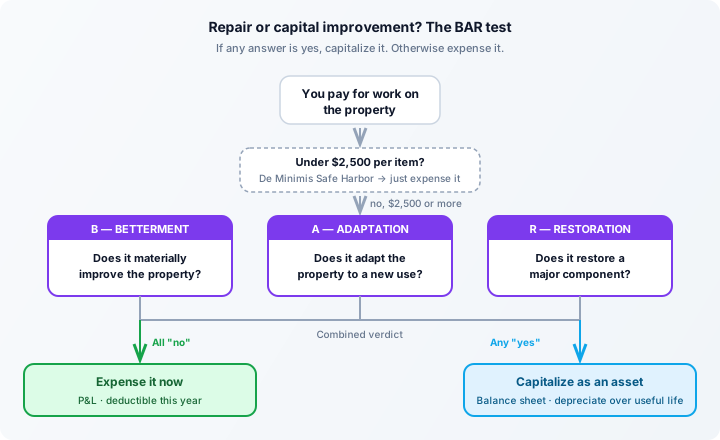
This is the second-most-common mistake in rental bookkeeping, right after security deposits. The IRS draws a hard line:
- Repairs restore something to its previous working condition. A leaky faucet, a broken window, a patched section of drywall. These are expenses, deductible immediately on your income statement.
- Capital improvements add value, extend the useful life, or adapt the property to a new use. A new roof, an HVAC system, a kitchen remodel. These are assets, recorded on your balance sheet and depreciated over time.
On April 18, Marco pays $8,200 for a new HVAC system in Unit A. This is not an expense; it's a capital improvement:
| Account | Debit | Credit |
|---|---|---|
| Capital Improvements | $8,200 | |
| Property Checking | $8,200 |
The $8,200 sits on Marco's balance sheet as an asset, not on his income statement. Your job right now is just to record it in the right place. The depreciation (spreading the cost over future years as a tax deduction) is something your CPA will calculate when preparing your tax return. They'll determine the correct recovery period, the method, and whether a Section 179 or bonus depreciation election makes sense. What matters for your books is that you don't expense it: if Marco had recorded the full $8,200 as "Maintenance and Repairs," his April P&L would drastically understate his actual profitability and he'd be misrepresenting his books.
Note: When in doubt about whether something is a repair or an improvement, ask your CPA before recording it. The IRS test under the tangible property regulations is the BAR test: anything that Betters the property, Adapts it to a new use, or Restores a major component must be capitalized. Anything below the $2,500 De Minimis Safe Harbor can usually be expensed regardless of category. Larger gray-area items deserve a five-minute call with your accountant before you book them.
Recording a mortgage payment
Marco's April mortgage on the duplex is $1,158. But a mortgage payment isn't a single expense; it has two parts:
- Interest ($980): a deductible expense, the cost of borrowing money
- Principal ($178): a liability reduction, paying down what you owe the bank
| Account | Debit | Credit |
|---|---|---|
| Mortgage Interest | $980 | |
| Mortgage Payable | $178 | |
| Property Checking | $1,158 |
Your lender's amortization schedule shows the interest-vs-principal split for each month. The interest portion hits your income statement as an expense; the principal portion reduces the Mortgage Payable balance on your balance sheet. Since this entry is identical in structure every month (only the interest/principal split changes slightly), save it as a template and update the amounts each month.
Depreciation: a deduction without spending cash
Residential rental property is depreciated over 27.5 years using the straight-line method. Only the building is depreciable; land doesn't wear out, so you subtract the land value from your purchase price.
Marco bought the Elm Street duplex for $225,000. The county assessment values the land at $50,000, giving him a depreciable basis of $175,000.
Monthly depreciation: $175,000 ÷ 27.5 years ÷ 12 months = $530.30
| Account | Debit | Credit |
|---|---|---|
| Depreciation Expense | $530.30 | |
| Accumulated Depreciation | $530.30 |
No cash moves in this entry. Depreciation is a non-cash expense that reduces your taxable income, one of the biggest tax advantages of owning rental property. On the balance sheet, Accumulated Depreciation is a contra-asset: it reduces the carrying value of the Rental Property account without changing the original cost. If you want to understand how contra-assets fit into the accounting equation, the linked guide covers it.
Note: Depreciation starts when the property is "placed in service" (available for rent), not when you bought it. If you purchased mid-year, your first-year deduction is prorated. Your CPA handles the exact calculation for your tax return; your job is to record the monthly entry so your books match.
Owner draws
On April 25, Marco transfers $2,000 from the LLC checking account to his personal account:
| Account | Debit | Credit |
|---|---|---|
| Member Draw | $2,000 | |
| Property Checking | $2,000 |
A draw is not an expense; it doesn't appear on your income statement. It's a reduction of equity: Marco is taking money out of the business for personal use. In Twin Owls, the Equity page shows your running draw balance so you always know how much you've taken out during the year.
Handling vacancies
When a unit sits empty between tenants, there's no entry to make. Vacancy is the absence of revenue, not a transaction. But every other expense continues: the mortgage, insurance, HOA, property tax, and depreciation don't pause because a unit is unoccupied.
Your income statement will show a loss during heavy vacancy months. That's normal and expected. For tax purposes, rental losses may offset other passive income on your return, subject to the IRS passive activity loss rules (your CPA can advise on whether you qualify for the $25,000 special allowance under IRC § 469).
Month-end: pulling it all together
At the end of April, Marco opens the Reports page in Twin Owls and runs a profit-and-loss statement for Reyes Property LLC, April 1–30, 2026.
April P&L, Reyes Property LLC
| Line | Amount |
|---|---|
| Revenue | |
| Rental Income | $3,200.00 |
| Total Revenue | $3,200.00 |
| Expenses | |
| HOA Fees | $275.00 |
| Maintenance and Repairs | $450.00 |
| Mortgage Interest | $980.00 |
| Depreciation Expense | $530.30 |
| Total Expenses | $2,235.30 |
| Net Income | $964.70 |
The duplex generated $964.70 in profit for April. But notice: the $8,200 HVAC and the $178 mortgage principal don't appear here. The HVAC is on the balance sheet as a capital improvement, and the $178 of principal reduced a liability; neither is an expense. Meanwhile, $530.30 of depreciation does appear even though Marco didn't spend any cash on it.
This is exactly why you need both statements. The P&L tells you the property is profitable. The balance sheet tells you where the cash actually went (and that you're sitting on a $1,550 security deposit liability). The reading financial statements guide walks through how to read the two together.
Marco's monthly rhythm going forward:
- Week 1–4: Record rent deposits and expenses as they happen
- Month-end: Record the depreciation entry
- Month-end: Run the P&L and balance sheet, check that nothing looks off
- Quarterly: Review trends. Is maintenance creeping up? Are rents keeping pace with expenses?
This takes roughly 30 minutes per month once the accounts and templates are set up.
Key takeaway
Rental property bookkeeping comes down to a monthly rhythm: record income, record expenses, review reports. The two biggest mistakes are treating security deposits as income (they're liabilities) and expensing capital improvements (they're assets). Get those right, be specific in your descriptions, attach your receipts, and your books will be clean enough for your CPA and useful enough to make real decisions about the property.
Frequently asked questions
Is a security deposit income? No. A security deposit is a liability: money you hold on behalf of the tenant and must return (minus legitimate deductions for damages) when they move out. Record it as a credit to a Security Deposits Held liability account, not as revenue.
What's the difference between a repair and a capital improvement? A repair restores something to its previous condition (fixing a leaky faucet, patching drywall, replacing a broken window). It's deductible immediately as an expense. A capital improvement adds value, extends useful life, or adapts the property to a new use (new roof, HVAC system, kitchen remodel). It must be capitalized as an asset and depreciated over its useful life.
How do I depreciate a rental property? Residential rental property is depreciated over 27.5 years using the straight-line method. Only the building value is depreciable; subtract the land value from your purchase price. Divide the depreciable basis by 27.5 years and by 12 months for the monthly depreciation entry.
How do I record a mortgage payment? Split it into two parts: the interest portion is a deductible expense (debit Mortgage Interest), and the principal portion reduces your loan balance (debit Mortgage Payable). Credit your bank account for the full payment amount. Your lender's amortization schedule tells you the split each month.
Should I use a separate LLC for each rental property? It depends on your risk tolerance and your attorney's advice. A separate LLC per property isolates liability: a lawsuit against one property can't reach the others. The trade-off is more paperwork: separate bank accounts, separate tax returns, and separate books. Twin Owls makes the bookkeeping side easy with multi-entity workspaces, but talk to your attorney about the legal structure.
Do I need to record anything when a unit is vacant? No entry is needed for the vacancy itself; it's the absence of revenue. But expenses like mortgage interest, insurance, HOA fees, and depreciation continue regardless of occupancy. Your income statement will show a loss during heavy vacancy months, which is normal.
Related
- Chart of accounts setup: creating and organizing the accounts your reports are built on
- Multi-entity accounting: managing multiple properties or LLCs in one workspace
- Journal entries explained: the mechanics behind every entry in this guide
- Debits and credits: why expenses are debits and revenue is credits
- Reading financial statements: how to interpret the P&L and balance sheet you just generated
Disclaimer
This guide explains how to record common rental property transactions in a double-entry bookkeeping system. It is not tax, legal, or financial advice. Depreciation schedules, passive activity loss rules, state landlord-tenant laws, and entity structuring decisions vary by jurisdiction and individual circumstance. Consult your CPA or tax advisor for guidance specific to your situation.
Try it in Twin Owls
See this in action in the app. Open in app