2025 Tax Brackets, IRA, 401(k), and HSA Limits: What You Need to Know
Federal tax brackets for 2025, plus contribution limits and tax benefits for Traditional IRA, Roth IRA, 401(k), Roth 401(k), and HSA accounts — with deduction rules and income phase-outs.
Published January 15, 2026 · Updated April 13, 2026
Tax season is simpler when you know two things: what rate you are paying on each dollar of income, and which accounts let you keep more of it. This guide covers the 2025 federal tax brackets and the four tax-advantaged accounts that most business owners and investors should know about: Traditional IRA, Roth IRA, 401(k), and HSA.
2025 federal tax brackets
The U.S. uses a marginal tax system. You do not pay a single rate on all your income — each chunk of income is taxed at its own rate. The first dollars you earn are taxed at 10%, the next chunk at 12%, and so on. Only the income above each threshold is taxed at the higher rate.
| Rate | Single | Married Filing Jointly | Head of Household | Married Filing Separately |
|---|---|---|---|---|
| 10% | Up to $11,925 | Up to $23,850 | Up to $17,000 | Up to $11,925 |
| 12% | $11,926 - $48,475 | $23,851 - $96,950 | $17,001 - $64,850 | $11,926 - $48,475 |
| 22% | $48,476 - $103,350 | $96,951 - $206,700 | $64,851 - $103,350 | $48,476 - $103,350 |
| 24% | $103,351 - $197,300 | $206,701 - $394,600 | $103,351 - $197,300 | $103,351 - $197,300 |
| 32% | $197,301 - $250,525 | $394,601 - $501,050 | $197,301 - $250,500 | $197,301 - $250,525 |
| 35% | $250,526 - $626,350 | $501,051 - $751,600 | $250,501 - $626,350 | $250,526 - $375,800 |
| 37% | Over $626,350 | Over $751,600 | Over $626,350 | Over $375,800 |
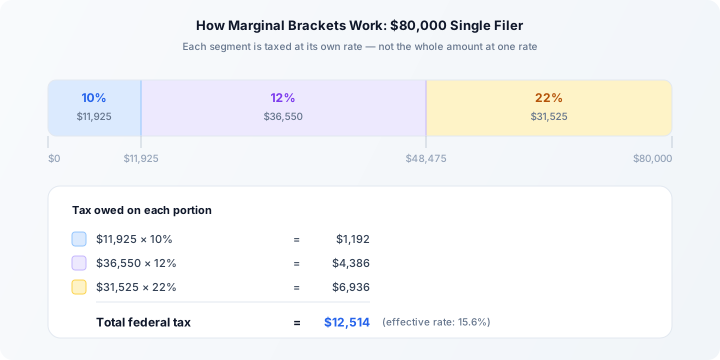
Note: These are federal rates only. Your state may have its own income tax brackets on top of these. The brackets shown here apply to taxable income — after deductions. For 2025, the standard deduction is $15,000 (single), $30,000 (married filing jointly), or $22,500 (head of household). That means a single filer earning $95,000 has taxable income of $80,000 before any other deductions.
Why this matters for business owners: Tax-advantaged accounts like IRAs, 401(k)s, and HSAs reduce your taxable income, which can keep more of your earnings in a lower bracket. A $7,000 Traditional IRA contribution for someone in the 24% bracket saves $1,680 in federal tax.
Traditional IRA
A Traditional IRA is an individual retirement account where contributions may be tax-deductible — meaning they reduce your taxable income in the year you contribute.
2025 contribution limits
| Under 50 | Age 50+ | |
|---|---|---|
| Annual limit | $7,000 | $8,000 |
Is a Traditional IRA tax-deductible?
It depends on whether you (or your spouse) have a retirement plan at work:
No workplace plan: Your full contribution is deductible regardless of income.
You have a workplace plan (single filer):
| MAGI | Deduction |
|---|---|
| $79,000 or less | Full deduction |
| $79,001 - $89,000 | Partial deduction |
| Over $89,000 | No deduction |
You have a workplace plan (married filing jointly):
| MAGI | Deduction |
|---|---|
| $126,000 or less | Full deduction |
| $126,001 - $146,000 | Partial deduction |
| Over $146,000 | No deduction |
You don't have a workplace plan, but your spouse does (married filing jointly):
| MAGI | Deduction |
|---|---|
| $236,000 or less | Full deduction |
| $236,001 - $246,000 | Partial deduction |
| Over $246,000 | No deduction |
This is a common scenario for business owners whose spouse has a 401(k) at work. The phase-out is much higher because you're not directly covered by a plan — but it still exists.
Even if your contribution is not deductible, the earnings inside the account grow tax-deferred — you do not pay taxes on gains until you withdraw in retirement.
Benefits
- Reduces taxable income now (if deductible)
- Earnings grow tax-deferred
- No income limit to contribute (unlike Roth IRA)
- Deadline: April 15, 2026 for tax year 2025 contributions
Roth IRA
A Roth IRA works in reverse: contributions are not tax-deductible, but qualified withdrawals in retirement are completely tax-free — including all the growth.
2025 contribution limits
| Under 50 | Age 50+ | |
|---|---|---|
| Annual limit | $7,000 | $8,000 |
The combined limit across Traditional and Roth IRAs is $7,000 ($8,000 if 50+). You can split between them, but the total cannot exceed the limit.
Income limits
Unlike Traditional IRAs, Roth IRAs have income eligibility limits:
Single filers:
| MAGI | Contribution |
|---|---|
| Under $150,000 | Full contribution |
| $150,000 - $165,000 | Partial contribution |
| Over $165,000 | Not eligible |
Married filing jointly:
| MAGI | Contribution |
|---|---|
| Under $236,000 | Full contribution |
| $236,000 - $246,000 | Partial contribution |
| Over $246,000 | Not eligible |
Note: If your income exceeds the Roth IRA limits, you can use a backdoor Roth strategy: contribute to a nondeductible Traditional IRA, then convert it to a Roth. Consult your CPA before doing this — the pro-rata rule can create unexpected taxes if you have other Traditional IRA balances.
Benefits
- Withdrawals in retirement are tax-free (contributions and earnings)
- No required minimum distributions (RMDs) during your lifetime
- Contributions (not earnings) can be withdrawn anytime without penalty
- Ideal if you expect to be in a higher tax bracket in retirement
401(k) and Roth 401(k)
A 401(k) is an employer-sponsored retirement plan with significantly higher contribution limits than IRAs. Most plans offer both a Traditional 401(k) (pre-tax contributions, taxed on withdrawal) and a Roth 401(k) (after-tax contributions, tax-free withdrawal).
2025 contribution limits
| Under 50 | Age 50+ | Age 60-63 | |
|---|---|---|---|
| Employee contribution | $23,500 | $31,000 | $34,750 |
| Catch-up amount | — | $7,500 | $11,250 |
The standard catch-up ($7,500) applies to everyone 50 and older. The SECURE 2.0 Act adds a higher catch-up ($11,250) specifically for ages 60-63 — after 63, it reverts to $7,500.
Traditional 401(k) vs. Roth 401(k)
| Traditional 401(k) | Roth 401(k) | |
|---|---|---|
| Tax on contributions | Pre-tax (reduces taxable income now) | After-tax (no deduction) |
| Tax on withdrawals | Taxed as ordinary income | Tax-free |
| Best if you expect | Lower tax bracket in retirement | Higher tax bracket in retirement |
| RMDs | Required at age 73 | No longer required (as of 2024) |
No income limits. Unlike Roth IRAs, Roth 401(k) contributions have no income phase-out — any employee can contribute regardless of how much they earn.
Benefits
- Highest contribution limits of any individual retirement account
- Employer match (if offered) is essentially free money
- Traditional: immediate tax savings through lower taxable income
- Roth: tax-free growth and withdrawals in retirement
Health Savings Account (HSA)
An HSA is the only account in the tax code with a triple tax advantage: contributions are tax-deductible, earnings grow tax-free, and withdrawals for qualified medical expenses are tax-free. No other account does all three.
2025 contribution limits
| Self-only | Family | |
|---|---|---|
| Annual limit | $4,300 | $8,550 |
| Age 55+ catch-up | +$1,000 | +$1,000 |
| Total (55+) | $5,300 | $9,550 |
Eligibility
You must be enrolled in a High Deductible Health Plan (HDHP) to contribute. For 2025, your HDHP must have a minimum deductible of $1,650 (self-only) or $3,300 (family).
Benefits
- Triple tax advantage: deductible contributions + tax-free growth + tax-free withdrawals for medical expenses
- Unused funds roll over indefinitely (no "use it or lose it")
- After age 65, withdrawals for any purpose are penalty-free (taxed as income if not for medical expenses — similar to a Traditional IRA at that point)
- Can be invested in stocks, bonds, and mutual funds for long-term growth
- Deadline: April 15, 2026 for tax year 2025 contributions
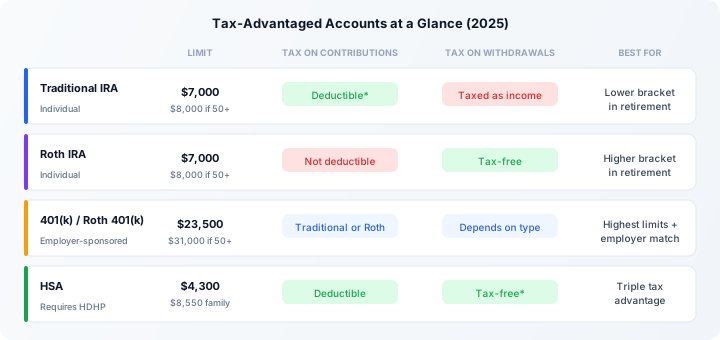
Which accounts should you use?
The answer depends on your situation, but here are general guidelines:
- Everyone: If you have an HDHP, max out your HSA first — no other account gives you a triple tax benefit.
- Employees with a 401(k): Contribute at least enough to capture the full employer match, then decide between Traditional and Roth based on your expected future tax bracket.
- Self-employed or no 401(k): Look into a Solo 401(k) (also called an Individual 401(k)) — it has the same $23,500 employee limit as a regular 401(k) plus up to 25% of net self-employment income in employer contributions. If that's not an option, use a Traditional or Roth IRA. If your income is below the deduction phase-out, Traditional gives you an immediate tax break. If you expect higher income later, Roth locks in today's lower rate.
- High earners: If you exceed Roth IRA income limits, consider the backdoor Roth strategy or maximize Roth 401(k) contributions (no income limit).
Key takeaway
Tax brackets determine how much you owe. Tax-advantaged accounts determine how much of your income is even subject to those brackets. A self-employed business owner who contributes $23,500 to a Solo 401(k) and $4,300 to an HSA reduces their taxable income by $27,800 — which at a 24% marginal rate saves nearly $6,700 in federal tax. Add a $7,000 Traditional IRA deduction (if eligible) and the savings top $8,300. The contribution deadlines for IRAs and HSAs are April 15, 2026 — you still have time to contribute for tax year 2025.
Related
- The Augusta Rule: rent your home to your business tax-free — another tax strategy for business owners
- Accounting basics — how income and expenses flow through your books
References
- IRS: Tax inflation adjustments for 2025 — official bracket and limit announcements
- IRS: 401(k) and IRA limits for 2025 — contribution limit details
- IRS Publication 969: Health Savings Accounts — HSA rules and eligibility
Disclaimer
This article is for informational purposes only and does not constitute tax, financial, or investment advice. Tax laws change frequently. Consult a qualified CPA or tax advisor for guidance specific to your situation.
Try it in Twin Owls
See this in action in the app. Open in app