
Accountable Plans: How to Reimburse Yourself (and Employees) Tax-Free
An accountable plan lets your business reimburse you (and your team) for home office, mileage, cell phone, and travel expenses tax-free. Here's the IRS rule, who needs one, and how to set it up.
10 min readPublished April 7, 2026 · Updated April 20, 2026
If you own an S-Corp, C-Corp, partnership, or any business with employees (including yourself), there's a specific IRS arrangement that lets the business pay you back for personal money you spent on business purposes, with zero tax consequences on either side. The business deducts the reimbursement, you receive the cash tax-free, and none of it runs through payroll.
It's called an accountable plan, and it's defined in Treasury Regulation § 1.62-2. For S-Corp owner-employees, it's one of the highest-leverage tax tools available, and most small businesses don't have one set up.
One-sentence definition: an accountable plan is a set of reimbursement practices that meets three IRS tests (business connection, substantiation, and return of excess), under which payments from an employer to an employee for business expenses are excluded from wages and deductible by the employer. It is not a form you file, an account you open, or a tax election. The "plan" is the written rulebook that commits your business to following those three tests; the tax treatment follows automatically as long as you do.
At a glance
- What: a reimbursement arrangement that meets three IRS tests.
- Why: moves home office, mileage, and cell phone expenses tax-free from your personal return to the business return.
- Who: S-Corps, C-Corps, partnerships, and multi-member LLCs. Not sole proprietorships or single-member LLCs taxed as disregarded entities.
- Effort: a one-page plan document plus a monthly expense report.
- If you're a sole proprietor, this doesn't apply to you. Business expenses already flow directly onto Schedule C.
This guide covers what an accountable plan is, the three tests it must pass, what you can reimburse, how to calculate the big ones (home office and mileage), how to record reimbursements in Twin Owls, and how to set the whole thing up properly.
The problem it solves
Before 2018, if you paid for business expenses personally, you could deduct them on Schedule A of your personal return as "unreimbursed employee expenses," a miscellaneous itemized deduction subject to the 2% AGI floor. The Tax Cuts and Jobs Act suspended that deduction for tax years 2018 through 2025 under IRC § 67(g).
Unless Congress extends the suspension, the deduction is scheduled to return in 2026, but even then it only reaches expenses above 2% of AGI for itemizers, which isn't useful to most owner-employees. For practical purposes, if you personally pay for something business-related today and the business doesn't reimburse you, the deduction is effectively gone.
That creates a real problem for:
- S-Corp owner-employees who pay for their home office, cell phone, internet, or mileage personally
- C-Corp shareholder-employees in the same situation
- Any employee who fronts expenses for their employer
The accountable plan fixes this by moving those expenses from the personal return (where they can't be deducted) onto the business return (where they can).
There's also a defensive reason: without a formal plan, the reimbursements you're already making (the monthly transfer to cover your cell phone, the check you wrote yourself for a business trip) are likely being booked as owner draws or, worse, slipping into wages. Both create tax exposure the IRS routinely catches on audit. Adopting a plan isn't just about unlocking a new deduction; it's about cleaning up the reimbursements you already do.
What Treasury Reg. § 1.62-2 actually requires
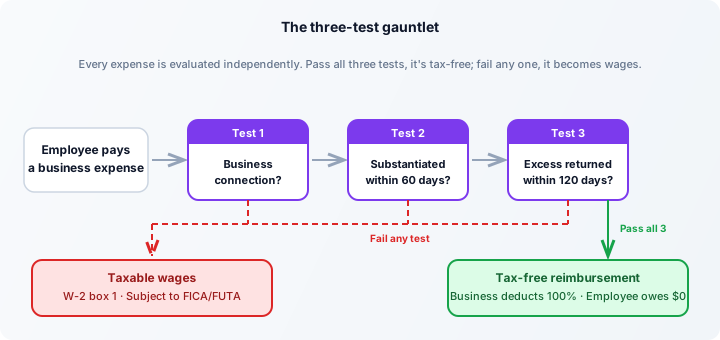
A reimbursement qualifies as excludable from wages (meaning it's tax-free to the recipient and fully deductible to the employer) only if it meets all three of the following tests. Fail any one and the entire payment is recharacterized as taxable wages.
1. Business connection
The expense must be paid or incurred by the employee in connection with services performed as an employee, and it must be the kind of expense that would be deductible as a business expense under IRC § 162 if the employee had incurred it on their own return. Personal expenses don't count, no matter how you label them.
2. Substantiation within a reasonable time
The employee must substantiate each expense with documentation adequate to establish:
- The amount (receipt or mileage log)
- The time and place (date, city)
- The business purpose (what meeting, what client, what project)
The IRS safe harbors for "reasonable time" are:
- 60 days after the expense is paid or incurred, or
- 120 days after an advance is received
Expenses documented later risk disqualification.
3. Return of excess within a reasonable time
If the business pays an advance (say, $500 upfront for a trip), the employee must return any unused portion. Using the safe harbor above, that's 120 days after the advance. Plans that let employees keep unused advances are automatically non-accountable: every dollar advanced becomes wages.
Note: These three tests apply per expense, not per plan. One expense reimbursed without substantiation won't taint the others, but that one becomes wages subject to payroll tax.
Accountable vs. non-accountable plans
| Accountable Plan | Non-Accountable Plan | |
|---|---|---|
| Taxable to employee | No | Yes, full amount |
| W-2 box 1 (wages) | Excluded | Included |
| Subject to FICA/FUTA (Social Security, Medicare, federal unemployment) | No | Yes |
| Employer deduction | 100% as business expense | 100% as wages (plus payroll tax expense) |
| Required documentation | Receipts, logs, business purpose | None |
| Excess must be returned | Yes | No |
The punchline: a dollar moved from your personal return onto the business return reduces taxable business income by that dollar. For an S-Corp owner, that flows through to your K-1 (the form that passes S-Corp income to your 1040) and reduces the income you pay ordinary tax on.
Your actual savings equal your marginal federal rate + your state rate applied to the reimbursement, not a flat 30-45%. For a $10,000 reimbursement at a 24% federal + 5% state marginal rate, that's $2,900 in tax savings. Look up your bracket in the 2026 tax brackets guide to estimate your own number.
Who needs one (and who doesn't)
Should absolutely have one:
- S-Corporations (owner-employees and regular employees)
- C-Corporations
- Partnerships and multi-member LLCs with guaranteed-payment partners or employees
- Single-member LLCs taxed as an S-Corp
Doesn't apply:
- Sole proprietorships
- Single-member LLCs taxed as disregarded entities (default)
For the second group, you and the business are the same taxpayer. Expenses go straight onto Schedule C. No reimbursement needed and none possible.
What you can reimburse
Any expense that would be deductible under IRC § 162 if the business had paid it directly. IRS Publication 535 is the plain-English rundown of what qualifies as ordinary and necessary. The most common categories for owner-employees:
- Home office: square-footage portion of rent, mortgage interest, utilities, insurance, depreciation, repairs
- Mileage: business miles at the IRS standard rate
- Cell phone: business-use percentage of the monthly bill
- Internet: business-use percentage of the monthly bill
- Travel: airfare, lodging, rental cars, taxis/rideshare, baggage, Wi-Fi
- Business meals: 50% deductible. This covers client meals, meals during business travel, and meals with a clear business purpose. A narrow set of meals qualify for 100% deduction: company-wide recreational events (holiday party, picnic), meals reported as taxable wages to an employee, food made available to the general public, and de minimis items like break-room coffee.
- Entertainment: 0% deductible post-TCJA. Sporting events, concert tickets, golf outings, club dues, and similar entertainment expenses are not deductible under IRC § 274(a), even if clearly business-related. Your accountable plan can still reimburse an employee tax-free for entertainment incurred for the employer, but the business simply cannot deduct it.
- Office supplies and equipment: computers, monitors, software subscriptions, books
- Professional development: conferences, CE courses, industry dues, subscriptions
- Vehicle expenses: actual-expense method if you don't use standard mileage
- Health insurance premiums (S-Corp >2% shareholders have special rules; run through payroll, not the accountable plan)
The home office reimbursement: the big one
For an S-Corp owner-employee, the home office deduction you can't take personally becomes a home office reimbursement the corporation pays you monthly. The math mirrors Form 8829, and IRS Publication 587 walks through every line of it:
Step 1: Determine business-use percentage
Business % = square feet used regularly and exclusively for business ÷ total square feet of home
Example: A 200 sq ft office in a 2,000 sq ft home = 10%.
Step 2: Total annual home expenses
Add up for the year:
| Expense | Annual Amount |
|---|---|
| Rent (or mortgage interest + real estate tax) | $30,000 |
| Utilities (electric, gas, water) | $3,600 |
| Homeowner's / renter's insurance | $1,800 |
| Internet (if not reimbursed separately) | $900 |
| Repairs and maintenance (whole-house) | $1,200 |
| Depreciation (homeowners only; 39-yr SL on office portion) | varies |
| Total | $37,500 |
Step 3: Apply business-use percentage
$37,500 × 10% = $3,750 reimbursable for the year, or $312.50/month.
The S-Corp writes you a check for $312.50 each month, expenses it as "Home Office Reimbursement," and deducts the full $3,750 on its return. You receive $3,750 tax-free.
Note: Keep an annual worksheet documenting the calculation. The IRS does not require you to submit it, but in an audit it's the first document they'll ask for. Re-run the calculation every January for the prior year's actual numbers.
Simplified method: usually a worse deal
The IRS also allows a simplified home office calculation of $5 per square foot, capped at 300 sq ft ($1,500/year max). For most owner-employees paying real rent or a mortgage, the actual-expense method above beats it by several thousand dollars per year.
Mileage reimbursement
The cleanest way to reimburse vehicle expenses is the IRS standard mileage rate. The rate changes annually and is published each December for the following year in an IRS notice. Recent business-use rates:
| Year | Rate per business mile | Source |
|---|---|---|
| 2024 | $0.67 | IRS Notice 2024-08 |
| 2025 | $0.70 | IRS Notice 2025-05 |
Always use the rate in effect for the year the miles were driven. The IRS standard mileage rates page lists the current and historical rates.
Required documentation for each trip:
- Date
- Starting location and destination
- Business purpose (client name, meeting, errand)
- Miles driven
A phone-based mileage tracker (MileIQ, TripLog, Everlance) produces a compliant log automatically. A handwritten notebook works too. The IRS cares about contemporaneous records, not the medium. The full substantiation rules for travel, vehicle, and meal expenses live in IRS Publication 463.
At 15,000 business miles per year × $0.70 (2025 rate), that's $10,500 reimbursed tax-free. Combined with a home office reimbursement and a cell phone/internet reimbursement, a typical S-Corp owner-employee shifts five figures of previously non-deductible personal spending onto the business return each year. The exact amount depends on your home, your mileage, and your bill amounts. Run your own numbers before expecting a specific total.
Cell phone and internet
Both are reimbursed on a business-use percentage of the monthly bill. You don't need itemized call logs; a reasonable estimate (e.g. "70% business") documented once per year is the standard practice. Keep one monthly statement as evidence of the bill amount.
Example: $120/month phone bill × 70% business use = $84/month reimbursement = $1,008/year.
When to adopt
You can adopt an accountable plan any time during the year, but it only reimburses expenses incurred on or after the effective date. An expense from January cannot be reimbursed under a plan adopted in July; retroactive reimbursement fails the business-connection test.
Pair the effective date with the start of a clean month (e.g. adopt on June 30, effective July 1), then substantiate each month's expenses within 30 days to stay comfortably inside the 60-day safe harbor. The cleanest scenario is adopting effective January 1 of a new tax year so the plan covers a full twelve months with no stub period.
Setting up your plan in four steps
1. Write the plan document
One or two pages, adopted by the business. At minimum it should state:
- That the plan is intended to qualify under Treas. Reg. § 1.62-2
- What expenses are eligible for reimbursement
- The substantiation requirements (receipts, mileage logs, business purpose)
- The submission deadline (e.g. 30 days after month-end)
- The return-of-excess requirement for advances
- The approval process
Your CPA or payroll provider can supply a template tailored to your entity type.
Corporations (S-Corp and C-Corp) should formally adopt the plan via a board resolution: a one-page document signed by the directors (or sole director, if that's you) stating that the plan is adopted effective [date]. File it in the corporate minute book alongside your articles and bylaws. A single-member S-Corp can pass this as a written consent in lieu of a meeting (same document, one signature, no meeting required).
Partnerships and multi-member LLCs adopt the plan through the operating or partnership agreement, or via a written consent of the members.
2. Create a standard expense report form
Paper, spreadsheet, or an app (Expensify, Ramp, Rippling). The form should capture: date, category, amount, business purpose, receipt attached (yes/no). Monthly cadence works best; quarterly stretches the "reasonable time" test.
3. Set a reimbursement cadence
The business issues a reimbursement check (or ACH) on a fixed schedule. Monthly is typical for owner-employees, alongside a regular payroll cycle but separate from it. The payment must be clearly identified as an accountable plan reimbursement, not wages.
4. Keep the records
Retain expense reports, receipts, mileage logs, and the annual home office calculation for at least 4 years (the standard IRS audit window; 6 years if income is understated by more than 25%).
Recording reimbursements in Twin Owls
Reimbursements are not payroll. They are ordinary business expenses, categorized by their underlying nature in your chart of accounts, paid from the business bank account to the employee's personal account. Each reimbursement becomes a standard journal entry: debit the relevant expense account and credit checking.
Example: $312.50 monthly home office reimbursement to the owner
| Account | Debit | Credit |
|---|---|---|
| Home Office Expense (or Rent: Office) | $312.50 | |
| Business Checking | $312.50 |
Example: $840 mileage reimbursement for the quarter (1,200 mi × $0.70 at the 2025 rate)
| Account | Debit | Credit |
|---|---|---|
| Auto / Mileage Expense | $840.00 | |
| Business Checking | $840.00 |
Example: Multi-category monthly expense report, $450 total
| Account | Debit | Credit |
|---|---|---|
| Home Office Expense | $312.50 | |
| Telephone Expense | $84.00 | |
| Office Supplies | $53.50 | |
| Business Checking | $450.00 |
Good practice in Twin Owls:
- Create dedicated expense accounts (e.g. "Home Office Reimbursement," "Mileage Reimbursement") so they're easy to pull at tax time
- Attach the approved expense report and receipts as documents on the journal entry or transaction
- Reference the plan in the memo (e.g. "Accountable plan reimbursement, March 2026")
- Do not post reimbursements to a payroll account, an owner-draw account, or a shareholder loan
A worked example: Sarah's first month
Sarah is the sole owner-employee of Sarah Consulting S-Corp. On March 1 she adopts an accountable plan (effective March 1) by signing a one-page plan document and a written consent in lieu of a board meeting. She stores both in a "Corporate Records" folder alongside her articles of incorporation.
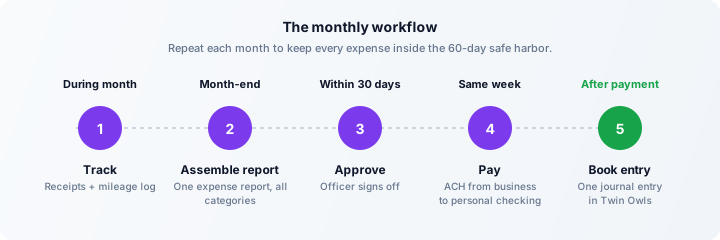
Throughout March she uses a mileage tracker app and keeps receipts in her email. At the end of March she sits down and puts together one expense report covering the month:
| Category | Calculation | Amount |
|---|---|---|
| Home office | $37,500 annual home expenses × 10% business use ÷ 12 months | $312.50 |
| Business mileage | 340 mi × $0.70 (2025 rate) | $238.00 |
| Cell phone | $120 bill × 70% business use | $84.00 |
| Internet | $80 bill × 60% business use | $48.00 |
| Client lunch (Mar 14) | Receipt attached; 50% deductible handled at tax time | $62.00 |
| Total to reimburse | $744.50 |
She attaches the mileage log, her March cell and internet statements, and the lunch receipt to the expense report, then approves it (as the authorized officer of the S-Corp).
On April 5 the S-Corp issues an ACH transfer of $744.50 from its business checking account to Sarah's personal checking account, with the memo "Accountable plan reimbursement, March 2026." In Twin Owls, she books one journal entry:
| Account | Debit | Credit |
|---|---|---|
| Home Office Reimbursement | $312.50 | |
| Mileage Reimbursement | $238.00 | |
| Telephone Expense | $84.00 | |
| Internet Expense | $48.00 | |
| Meals Expense | $62.00 | |
| Business Checking | $744.50 |
She attaches the signed expense report and supporting documents to the journal entry. That's the entire monthly workflow: track expenses during the month, assemble one report at month-end, approve, pay, book one journal entry. Roughly 30 minutes of work for $744.50 tax-free to Sarah and a $744.50 deduction for her S-Corp. Repeated monthly, that's $8,934 a year moved off her personal return and onto the business books.
Common mistakes that blow the plan
- Reimbursing without substantiation. A check with no backing expense report is a draw, not a reimbursement. The IRS will recharacterize it as wages on audit.
- Reimbursing personal expenses. Your kid's cell phone plan, a family vacation called a "retreat," groceries for a "client dinner" at your house. These fail the business-connection test.
- Letting substantiation slide past 60 days. Backdating receipts is worse than missing the window; it signals fraud rather than sloppiness.
- Putting reimbursements through payroll. Box 1 wages by mistake, then trying to back them out. This triggers W-2 corrections, amended 941s, and months of cleanup.
- No written plan and no board resolution. In an audit, the auditor asks for the plan document first. "We just do it this way" isn't an answer.
- Flat monthly allowances with no reconciliation. A fixed $500/month "car allowance" with no mileage log is a non-accountable plan: taxable wages.
- Mixing S-Corp >2% shareholder health insurance in. Health premiums for owner-employees have their own rule: they go through payroll as wages (W-2 box 1), then get deducted above-the-line on the personal return. Don't reimburse them through the accountable plan.
Quick-start checklist
- Confirm entity type is S-Corp, C-Corp, partnership, or multi-member LLC
- Draft a written accountable plan document
- Adopt via board resolution (corporations) and store in minute book
- Identify reimbursable categories that apply to each employee
- Run the annual home office calculation
- Set up a mileage-tracking app for anyone driving for business
- Create an expense report template with a 30-day submission deadline
- Add Home Office, Mileage, Telephone, and Internet expense accounts in Twin Owls
- Schedule the first monthly reimbursement and book the journal entry
Frequently asked questions
Do I need an accountable plan if I'm a sole proprietor? No. A sole proprietor or single-member LLC reports business expenses directly on Schedule C; there's no separate employer to reimburse. Accountable plans exist to move expenses from the employee's personal return onto the employer's books. If the IRS treats you and your business as the same taxpayer, reimbursement is meaningless.
Why is this especially important for S-Corp owners? Since the 2018 Tax Cuts and Jobs Act, employees (including S-Corp owner-employees) can no longer deduct unreimbursed business expenses on their personal return. If your S-Corp doesn't reimburse you, those expenses simply aren't deductible anywhere. An accountable plan is the only compliant way to get the deduction back onto the business books.
Does an accountable plan need to be in writing? The IRS does not strictly require a written plan, but the three substantive tests (business connection, substantiation, and return of excess) must be followed. A written plan (and a board resolution, for corporations) is the standard of care; without one, you're arguing the facts from scratch if audited.
Can I reimburse expenses I paid months ago? Substantiation must happen within a "reasonable time." The IRS safe harbor is 60 days after the expense is incurred to substantiate, and 120 days to settle any advance. Reimbursing an expense from a year ago is not a reasonable time and risks disqualifying the reimbursement, which would turn it into taxable wages.
Is a reimbursement run through payroll? No. Reimbursements under a qualifying accountable plan are not wages. They don't go on Form W-2, aren't subject to income tax withholding, FICA, or FUTA, and don't show up in box 1, 3, or 5. They are recorded as a business expense in the relevant category (e.g. Travel, Office Expense), not as payroll.
Can I reimburse a portion of my home mortgage or rent? Yes, through a home office reimbursement calculated with the same method Form 8829 uses: square-footage percentage applied to rent or mortgage interest, utilities, insurance, and depreciation. The business reimburses you monthly and deducts the total. This replaces the home office deduction an S-Corp owner-employee cannot take personally.
What's the difference between an accountable plan and a per diem? A per diem is one specific method of substantiation under an accountable plan: a fixed daily rate for travel meals and lodging that the IRS accepts without receipts. You can run a full accountable plan that uses per diems for travel and actual-expense reimbursement for everything else.
Can the accountable plan cover contractors (1099 workers)? Technically the rules are written for the employer-employee relationship. For 1099 contractors, it's cleaner to either (a) have them bill you inclusive of expenses, or (b) reimburse against documented receipts and exclude the reimbursement from the 1099-NEC, which the IRS allows when an "accountable-plan-like" arrangement exists. Don't use a formal accountable plan as the mechanism for contractors.
Key takeaway
Without an accountable plan, the money you spend personally on behalf of your business is stranded: not deductible on your return, not reimbursable on the business return. With one, the same money becomes a tax-free reimbursement to you and a dollar-for-dollar business deduction. The savings equal your marginal tax rate applied to the amount reimbursed, and for most owner-employees that adds up to real money every year.
The requirements are strict but mechanical: write the plan, adopt it by resolution or written consent, substantiate every expense inside 60 days, return unused advances, and book the reimbursements as ordinary business expenses. Do those things and the plan does the rest.
Related
- The Augusta Rule: a complementary strategy that lets your business pay you tax-free for short-term use of your home
- Journal entries explained: the mechanics behind each reimbursement entry
- Chart of accounts setup: creating dedicated expense accounts so reimbursements are easy to pull at tax time
- 2026 tax brackets, IRA, 401(k), and HSA limits: find your marginal rate to estimate your actual savings
Disclaimer
Consult your CPA or tax advisor before adopting or modifying an accountable plan. State tax treatment, health insurance rules for greater-than-2% S-Corp shareholders, and partnership-specific nuances (such as guaranteed payments and separate partner-level arrangements) are not covered in detail here. This guide explains how the rule works; it is not tax advice.
References
- 26 CFR § 1.62-2, Reimbursements and other expense allowance arrangements: The controlling regulation
- IRS Publication 463, Travel, Gift, and Car Expenses: Substantiation rules, standard mileage, per diem
- IRS Publication 535, Business Expenses: What qualifies as an ordinary and necessary business expense
- IRS Publication 587, Business Use of Your Home: Calculation method for home office reimbursements
- Form 8829, Expenses for Business Use of Your Home: Reference worksheet for the home office calculation
Try it in Twin Owls
See this in action in the app. Open in app