
Can You Claim a Parent as a Dependent? Rules, Tests, and Tax Benefits
How to claim a parent as a dependent on your tax return, including the IRS qualifying relative tests, income and support thresholds, the multiple support agreement for siblings, and the tax benefits you unlock.
9 min readPublished April 27, 2026
Yes, you can claim a parent as a dependent on your federal tax return. The IRS treats parents as qualifying relatives, which means they don't need to live with you and there's no age requirement. But they do need to meet specific income and support tests, and getting those wrong can trigger an audit or a rejected return.
This guide walks through every test the IRS requires, explains what counts as "support," covers what happens when siblings share expenses, and lays out the tax benefits you unlock when your parent qualifies.
At a glance
- Parents qualify under the qualifying relative rules, not the qualifying child rules
- Your parent's gross income must be below $5,200 (2025 threshold; adjusted annually for inflation)
- You must provide more than half of your parent's total support for the year
- Your parent does not need to live with you
- Benefits include the Credit for Other Dependents ($500), potential Head of Household filing status, and deductible medical expenses you pay on their behalf
Qualifying child vs. qualifying relative
The IRS has two categories of dependents: qualifying children and qualifying relatives. Parents always fall under qualifying relative. This distinction matters because the tests are different. There's no age limit, no residency requirement, and the income threshold is what determines eligibility rather than whether the person is a student or under 19.
The five tests your parent must pass
To claim a parent as a dependent, the IRS requires you to satisfy all five of these tests. Failing any single one disqualifies the claim.
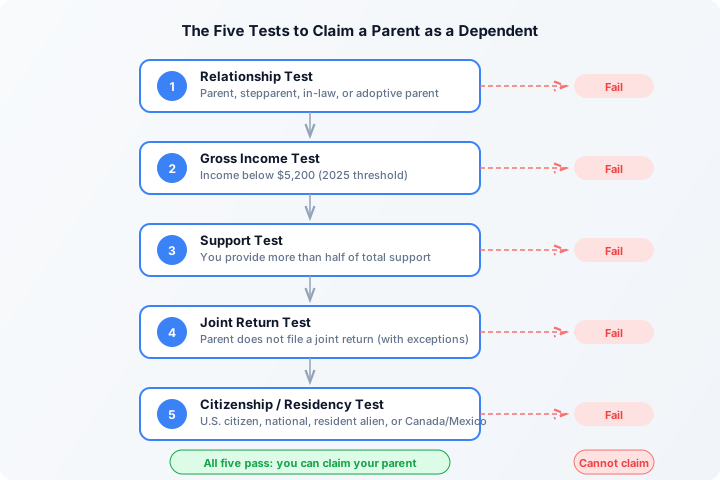
1. Relationship test
Your parent must be your biological mother or father, stepparent, or parent by legal adoption. In-laws (mother-in-law, father-in-law) also qualify. This test is straightforward and rarely the issue.
2. Gross income test
Your parent's gross income for the year must be less than the IRS threshold: $5,200 for 2025 ($5,050 for 2024). This number is adjusted annually for inflation.
Gross income includes wages, interest, dividends, rental income, and the taxable portion of pensions and Social Security. It does not include tax-exempt income like municipal bond interest or the non-taxable portion of Social Security benefits.
Note: Social Security is the most common source of confusion here. Many parents receive Social Security, but only a portion of it counts as gross income. If your parent's only income is Social Security and their combined income (adjusted gross income + non-taxable interest + half of Social Security) stays below $25,000 (single) or $32,000 (married filing jointly), none of the Social Security is taxable. Even above those thresholds, only 50% to 85% of the benefit is taxable. Run the numbers before assuming your parent's income is over the limit.
3. Support test
You must provide more than half of your parent's total support for the year. Total support includes:
- Housing: fair market rental value of the home (or actual rent/mortgage payments)
- Food: groceries and meals
- Clothing
- Medical and dental care: including insurance premiums
- Transportation
- Recreation and personal expenses
Money your parent spends from their own income (including Social Security) counts as self-support and works against you. If your parent receives $15,000 in Social Security and uses it for living expenses, and you contribute $16,000, you're providing just over half. But if your parent also has $3,000 in savings they spend on themselves, total support is $34,000 and your $16,000 is less than half.
Note: Keep records. The IRS may ask you to document your support contributions. Save receipts, bank statements showing transfers, and a simple spreadsheet tallying what you paid versus what your parent paid from their own resources. IRS Publication 501 includes a worksheet (Worksheet 1) specifically for calculating support.
4. Joint return test
If your parent is married, they generally cannot file a joint return with their spouse and still be claimed as your dependent. The exception: if they file jointly only to claim a refund of withheld taxes or estimated payments (meaning they have no tax liability on the joint return).
5. Citizenship or residency test
Your parent must be a U.S. citizen, U.S. national, U.S. resident alien, or a resident of Canada or Mexico for some part of the year.
When siblings share the cost: Multiple Support Agreements
If you and your siblings collectively provide more than half of your parent's support, but no single person contributes more than 50%, the IRS allows a Multiple Support Agreement using Form 2120.
Here's how it works:
- The group (you and your siblings) together must pay more than half of your parent's total support
- The person claiming the dependent must have contributed more than 10% of the support
- Every other person in the group who contributed more than 10% must sign a written waiver agreeing not to claim the parent that year
- The claiming person attaches Form 2120 to their return and keeps the signed waivers on file
Example: Three siblings support their mother. You pay 40%, your brother pays 35%, and your sister pays 25%. Together that's 100%. Any one of you can claim your mother, since all three contributed more than 10%. You agree that you'll claim her this year, your brother next year, and your sister the year after.
Note: Only one person can claim the parent in a given tax year. You cannot split the dependent across multiple returns. Rotate annually if the tax benefit varies by sibling.
Tax benefits of claiming a parent
Once your parent qualifies as your dependent, several tax benefits become available:
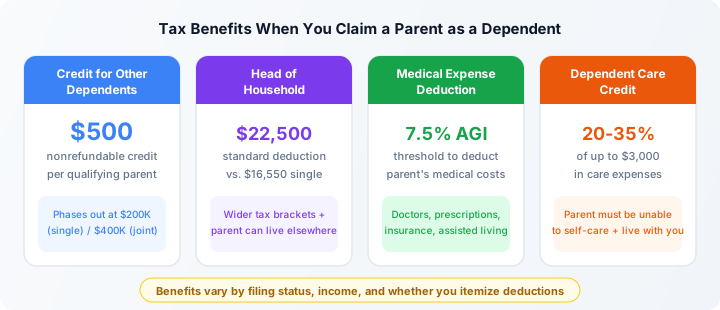
Credit for Other Dependents (ODC)
You can claim a $500 nonrefundable credit per qualifying relative (including a parent). This credit phases out at higher incomes ($200,000 AGI for single filers, $400,000 for married filing jointly). Unlike the Child Tax Credit, the ODC is not refundable, so it can reduce your tax to zero but won't generate a refund on its own.
Head of Household filing status
If you are unmarried and you claim your parent as a dependent, you may qualify to file as Head of Household even if your parent does not live with you. The requirement: you must pay more than half the cost of maintaining your parent's main home for the entire year.
Head of Household gives you a larger standard deduction ($22,500 vs. $16,550 for single filers in 2025) and wider tax brackets, which can save you hundreds to thousands of dollars depending on your income.
Medical expense deductions
If you itemize deductions, you can include medical expenses you pay for a dependent parent. This includes doctor visits, prescriptions, insurance premiums, long-term care insurance (subject to age-based limits), and assisted-living or nursing home costs that qualify as medical care. Medical expenses are deductible to the extent they exceed 7.5% of your AGI.
Dependent care credit
If your parent is physically or mentally unable to care for themselves and lives with you for more than half the year, expenses you pay for their care (so that you can work) may qualify for the Child and Dependent Care Credit. The maximum qualifying expense is $3,000 for one qualifying person, and the credit rate ranges from 20% to 35% depending on your income.
Common mistakes to avoid
- Forgetting self-support. Money your parent spends from their own income counts against your share. You need to account for their Social Security, pension, and savings withdrawals when calculating whether you provided more than half.
- Double-counting Social Security. The gross income test uses the taxable portion of Social Security, but the support test uses the total amount your parent spends from Social Security on their own living expenses. These are two different calculations.
- Claiming a parent who files jointly. If your parent files a joint return with their spouse (and they owe tax), you cannot claim them. Confirm their filing status before you file your own return.
- No documentation. The IRS can request proof of support at any time. Without receipts, bank records, or a support worksheet, your claim may be denied on audit.
Key takeaway
Claiming a parent as a dependent is entirely possible and can deliver meaningful tax savings through the Credit for Other Dependents, Head of Household filing status, and medical expense deductions. The two tests that trip people up are the gross income test (watch the taxable portion of Social Security) and the support test (track every dollar, including what your parent pays for themselves). If siblings share the cost, a Multiple Support Agreement on Form 2120 lets one person claim the benefit each year. Keep thorough records and consult your CPA if your parent's income is close to the threshold.
References
- IRS Publication 501: Dependents, Standard Deduction, and Filing Information: the authoritative source for dependent rules, including the support worksheet
- IRS: For Caregivers: IRS FAQ on claiming a parent as a dependent
- IRS Form 2120: Multiple Support Declaration: the form required when siblings share support costs
- IRS Publication 503: Child and Dependent Care Expenses: rules for the dependent care credit when caring for a parent
Disclaimer
This guide explains the general IRS rules for claiming a parent as a dependent. It is not tax, legal, or financial advice. Income thresholds, credit amounts, and phase-out ranges change annually. Your specific situation may involve additional factors (state taxes, treaty provisions, Medicaid implications) not covered here. Consult your CPA or tax advisor before making dependent claims on your return.
Try it in Twin Owls
See this in action in the app. Open in app