
Self-Employment Tax: What It Is, How It Compares to W-2, and How to Pay Less
A plain-English guide to self-employment tax: what it is, how it really compares to W-2 payroll tax (the 'double FICA' framing isn't quite right), how much you owe at common income levels, and four ways to legally lower your tax bill. Built for freelancers, side-hustlers, and small business owners, not CPAs.
12 min readPublished February 7, 2026 · Updated April 29, 2026
Two friends earn the same $80,000. One is a W-2 marketing manager; the other is a freelance designer with the same company as their main client. At year-end the W-2 employee feels about $5,000 richer. The freelancer feels confused.
Welcome to self-employment tax, the most surprising line on a self-employed person's return, and the most-misunderstood number in the freelance world. The popular framing ("self-employed people pay double FICA") is technically true and mostly misleading. The actual story is more interesting, and once you see it clearly, the path to lowering your bill becomes obvious.
This guide is for freelancers, side-hustlers, and small business owners, not for CPAs. We'll cover what self-employment tax actually is, what you really owe at common income levels, and four levers that lower your overall tax bill. By the end you'll have a working mental model and a list of questions you can take to your accountant.
At a glance
- The rate is 15.3% (12.4% Social Security + 2.9% Medicare), applied to 92.35% of your net business profit. The effective hit is about 14¢ on every dollar of profit
- W-2 workers pay the same total, just hidden: half is withheld from their paycheck, and their employer pays the other half from what would otherwise have been their salary. Self-employed workers see all of it because they are both employee and employer
- The 15.3% caps at the Social Security wage base ($176,100 for 2025). Above that, only the 2.9% Medicare portion continues, with an extra 0.9% above $200K single / $250K married
- The threshold for owing it is just $400 of net self-employment earnings. Side gigs count
- The biggest lever is electing S-Corp status once your business consistently profits above ~$100K. Below that, an S-Corp typically costs more than it saves
What self-employment tax actually is
If you have ever looked at a W-2 paystub, you have seen FICA: 6.2% Social Security tax and 1.45% Medicare tax withheld from your paycheck. That's the "employee half" of payroll tax. The employer pays a matching 6.2% + 1.45% directly to the IRS, on top of your salary. You never see that money, but it is part of what your employer budgets to employ you.
When you are self-employed, you are both the employee and the employer. There is no other party to split the bill with. So you pay the entire amount yourself: 12.4% Social Security + 2.9% Medicare = 15.3%. That is self-employment tax. It is filed on Schedule SE alongside your Form 1040 and reported on Schedule C (sole prop / single-member LLC) or Schedule E with K-1s (partnerships).
It is separate from federal income tax, which is why a self-employed person can owe income tax and a five-figure SE tax bill on the same business profit. The two stack.
The math (and why the headline rate isn't the real rate)
The actual computation has three subtleties worth knowing.
1. The 92.35% multiplier
You don't pay 15.3% on your full net earnings. You pay it on 92.35% of net earnings. The reason: by statute (IRC §1402(a)(12)), you are allowed to subtract the "employer-equivalent" portion of SE tax from your earnings before computing the tax. The math works out to 1 ÷ (1 + 0.5 × 15.3%) ≈ 0.9235.
The effective rate on your full net earnings is therefore 15.3% × 0.9235 = 14.13%.
2. The half-deduction
The employer-equivalent portion of SE tax (half of what you pay) is deductible above the line on Schedule 1 of Form 1040. It reduces your income tax base, not your SE tax base. This is the income-tax mirror of the §1402 adjustment, and it's why financial planning calculators almost always understate SE tax pain a bit at the surface (the headline number) and then quietly recover it (in the income tax line).
3. The Social Security wage base and Medicare surtax
The 12.4% Social Security tax stops at the annual wage base ($176,100 for 2025, indexed annually). Above that, only the 2.9% Medicare tax continues, indefinitely.
Above $200,000 single / $250,000 married filing jointly, an additional 0.9% Medicare surtax applies (this is the Additional Medicare Tax, not technically part of SE tax but in the same family, and it does apply to self-employment earnings).
Worked numbers at $80,000 net earnings
| Step | Calculation | Amount |
|---|---|---|
| Net SE earnings (Schedule C profit) | $80,000 | |
| × 92.35% multiplier | $80,000 × 0.9235 | $73,880 |
| × 15.3% SE rate | $73,880 × 0.153 | $11,304 |
| Half-deduction above the line | $11,304 ÷ 2 | $5,652 (income tax savings, not SE tax savings) |
Your SE tax bill at $80,000 of net earnings is roughly $11,300. If your marginal income tax rate is 22%, the half-deduction saves about $1,243 in income tax, bringing the combined SE-related cost to roughly $10,000 net.
The mental shortcut: at this income level, expect to owe roughly 14 cents in SE tax on every dollar of net profit, on top of whatever your income tax rate is. Two checks, same $80,000 base.
W-2 vs self-employed: an honest side-by-side
The popular framing is "self-employed people pay double FICA." That's true at the line-item level but misleading at the economics level. The W-2 employer's half is part of what they pay to employ you. If you are negotiating to leave a W-2 job and freelance for the same employer, the apples-to-apples comparison is not your old salary versus your new contract rate; it's your old salary plus your old employer's FICA versus your new contract rate.
| W-2 employee at $80,000 salary | Self-employed at $80,000 net SE earnings | Self-employed at $86,120 (W-2 + employer FICA) | |
|---|---|---|---|
| Payroll / SE tax paid by you | $6,120 (employee FICA only) | $11,304 (full 15.3% SE) | $12,170 |
| Employer-side FICA (paid by your employer) | $6,120 | $0 | $0 |
| Total Social Security + Medicare paid on your work | $12,240 | $11,304 | $12,170 |
| Federal income tax base (after half-SE deduction) | $80,000 | $74,348 | $80,037 |
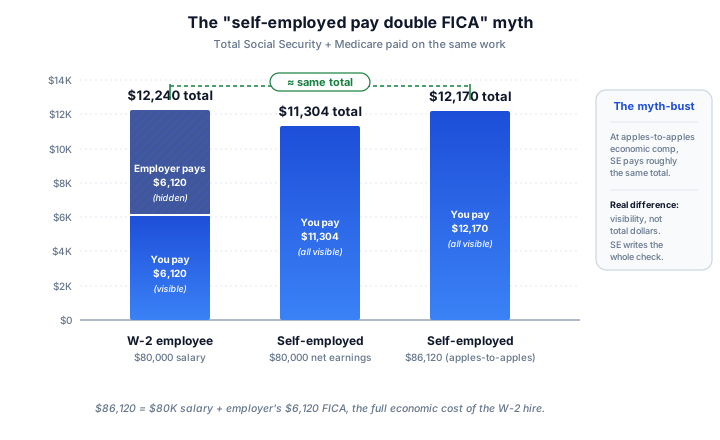
Two things stand out:
-
At apples-to-apples economic compensation (column 3), the self-employed person pays roughly the same total Social Security + Medicare as the W-2 employee. The "doubling" claim disappears once you compare what each side actually costs to fund.
-
At the same gross-paycheck comparison (column 1 vs column 2), the self-employed person pays more out of pocket because their employer isn't picking up the other half. This is the real-feel disadvantage when going independent, and the reason your contract rate has to be higher than your old W-2 salary just to break even.
The cleanest mental model: self-employed people don't pay more tax than equivalent W-2 employees; they pay the same tax more visibly. The W-2 employee's gross pay never shows the employer's $6,120; the self-employed person's gross income shows every dollar.
When you owe it (and when you don't)
You owe self-employment tax if your net earnings from self-employment are $400 or more in a year, and your activity is a trade or business (not a hobby).
You owe it on:
- Sole proprietorship / single-member LLC profit (Schedule C)
- Independent contractor / 1099-NEC income (Schedule C)
- General partnership and most multi-member LLC distributive shares (K-1 with self-employment earnings)
- Net farming income (Schedule F)
- Most freelance, gig, and consulting income
You do not owe it on:
- W-2 wages (you pay FICA instead, the equivalent on the employee side)
- Pure investment income: interest, dividends, capital gains
- Most rental real estate income (this is the most common surprise; passive landlords usually escape SE tax)
- S-Corp distributions in excess of reasonable salary (more on this below)
- Limited partner distributive shares (general partners pay; limited partners typically don't)
Note: The rental real estate carve-out is one of the most valuable rules in the code. A landlord with $40,000 of net rental profit pays income tax on it but not the ~$5,650 of SE tax that an equivalent freelancer would owe. This is one reason real estate is a tax-advantaged asset class for high earners. See our rental property bookkeeping guide for how to set up the books.
Four ways to lower your tax bill as a self-employed person
Some of these levers cut your SE tax directly. Some cut your income tax without touching SE tax. Both matter, and a good plan uses all four. We'll tag each one so the scope is clear.
1. Track every legitimate business deduction
[Cuts SE tax + income tax]
Every business expense (home office, vehicle, software, meals, professional fees, supplies, advertising, contractor payments) reduces your Schedule C profit, which lowers both your income tax base and your SE tax base. A $1,000 deduction at typical small-business rates (24% income tax + 14% effective SE) saves you about $381 in real tax.
Here's the mind-bender most freelancers miss: that same $1,000 of business expense is worth roughly $0 to a W-2 employee, who can't deduct unreimbursed business expenses at all (TCJA suspended that deduction in 2018, and OBBBA made the suspension permanent in 2025). The silver lining of being self-employed is that every legitimate business expense is worth ~38 cents on the dollar to you, while an identically-paid W-2 worker gets nothing for the same expense. That alone changes the math on whether to stay independent.
See our guides on the home office deduction and the vehicle and mileage deduction for two of the largest underused levers. Bookkeeping discipline (every receipt categorized, no purchases left in "personal") is the most boring and most consistent tax-saving habit.
2. Fund a self-employed retirement plan
[Cuts income tax only — does not reduce SE tax]
A SEP-IRA or Solo 401(k) lets you shelter a substantial chunk of profit from income tax. For 2025, a Solo 401(k) allows up to roughly $70,000 of combined employee + employer contributions. A SEP-IRA for a sole proprietor caps around 20% of net SE earnings (the 25% figure you'll often see online applies to W-2 compensation, not to Schedule C profit).
It's important to be honest about scope: retirement contributions reduce your income tax but they do not reduce your SE tax. SE tax is calculated on your net Schedule C profit before retirement plan contributions are subtracted. Still, the income tax savings are large: a consultant earning $150,000 net could shelter up to about $50,000 a year in a Solo 401(k), saving roughly $11,000 to $12,000 in federal income tax at the 22% to 24% bracket (more if income pushes into 32%). That money also compounds tax-deferred until retirement, which is a second economic win.
3. Elect S-Corp status (when profit justifies it)
[Cuts SE tax / FICA — the biggest lever for established businesses]
This is the single biggest tool for reducing payroll-style taxes. We cover the math in the next section.
4. Run business-use-of-personal expenses through an accountable plan (if S-Corp)
[Cuts income tax via the corporation, indirectly increases your distribution]
If you've elected S-Corp status, an accountable plan lets the corporation reimburse you tax-free for the business-use share of home office, mileage, and similar costs. The reimbursement is a deduction to the corporation (lowering its taxable income, which lowers your eventual distribution + salary tax) and is not taxable income to you. It doesn't directly reduce SE tax or FICA, but it captures business-use-of-personal expenses that S-Corp owner-employees can't claim on a personal return.
The S-Corp angle (worth its own section)
The single most important strategic decision for a successful self-employed person is whether to elect S-Corp status. Here is why.
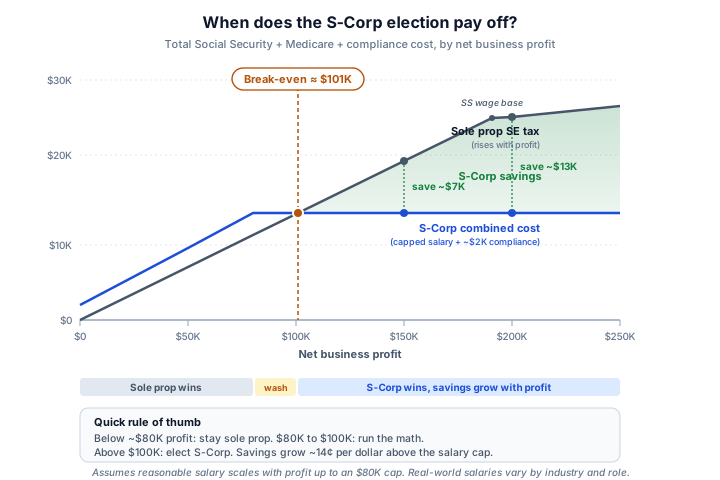
A sole proprietor or single-member LLC owner pays SE tax on all net business profit. If you net $150,000, you pay 14.13% on (almost) all of it: about $21,200 of SE tax.
An S-Corp owner-employee pays themselves a W-2 salary that is subject to FICA (the same 15.3% economically, split between owner and corp), and takes the rest of the profit as a distribution that is not subject to FICA or SE tax.
If your "reasonable salary" is $80,000 (defensible for the role and industry) and your business nets $150,000:
- Salary: $80,000 → ~$12,240 FICA total (your half + corp's half)
- Distribution: $70,000 → $0 SE tax, $0 FICA
- Combined payroll tax: ~$12,240 vs ~$21,200 as a sole prop
- Annual savings: ~$8,960
That's the S-Corp pitch in one paragraph. The chart below shows when this trade actually pays off, and when it doesn't.
The catches
-
The salary has to be defensible. The IRS scrutinizes "I run a $300K consulting practice and pay myself a $20K salary" because it is obvious gaming. Reasonable salary is what someone with your skills and your role would earn at a comparable employer. There are tools and benchmarking services that price this.
-
There are real costs. S-Corps file Form 1120-S, run payroll (you become an employee of your own company), handle FICA deposits, and often need a CPA. The compliance cost is typically $1,500 to $3,000 a year, which has to be netted against the SE tax savings.
-
The math only works above a threshold. Below roughly $60,000 to $80,000 of net business profit, the savings don't justify the compliance cost. Above that, savings grow linearly while costs stay roughly flat.
-
You can't capture the home office deduction the same way. S-Corp owner-employees can't deduct home office directly on a personal return; they reimburse through an accountable plan. Slightly more paperwork, same economic result.
The honest rule of thumb: at sustained net profit above $80,000 a year, run the S-Corp math. Above $150,000, it almost always pays. Below $60,000, stay a sole prop or single-member LLC and revisit when the numbers grow.
Things people commonly get wrong
-
"My LLC will save me on taxes." A single-member LLC taxed as a sole prop (the default) pays exactly the same SE tax as a sole prop with no LLC. The LLC gives you liability protection and a separate identity, not tax savings. The tax savings come from the S-Corp election an LLC can make, not from forming the LLC itself.
-
"I'll pay it at the end of the year." SE tax + income tax above $1,000 triggers quarterly estimated payments. Skipping them costs an underpayment penalty (currently around 8% annualized, recalculated quarterly). The IRS treats a year-end lump sum the same as four missed quarters, not as a single timely payment.
-
"My contract rate just needs to match my old W-2 salary." It needs to match your old salary plus your old employer's FICA contribution plus the value of any benefits (health insurance, 401(k) match, paid time off) you no longer get. A common rule of thumb: a fair freelance hourly rate is 1.5× to 2× your W-2 hourly equivalent to break even on take-home pay, depending on how generous your old benefits package was. Anything less and you are taking a real pay cut, even if the headline number looks higher.
-
"Self-employment tax = income tax." They are separate. You can owe substantial SE tax in a year when your income tax is zero (e.g., low net profit, large itemized deductions). The SE tax is independent of itemized deductions, the standard deduction, and income tax credits.
-
"Side gig under a few thousand dollars doesn't count." The threshold is $400 of net earnings, not gross. A side hustle that nets $500 owes Schedule SE.
Questions to take to your CPA
If you're new to self-employment, or considering going independent, or already self-employed and never had this conversation with your accountant, here are the questions worth asking. None of these have universal answers; they all depend on your numbers and your industry.
Note:
Conversation starters
-
"Based on my income, when should I start making quarterly estimated payments, and how much should each one be?" Most CPAs will help you set this up so you don't get hit with an underpayment penalty.
-
"Am I at the income level where an S-Corp election would actually pay off after compliance costs?" The break-even is roughly $100K of net profit, but it depends on industry, reasonable salary norms, and how much help you'd need with payroll.
-
"What's a defensible reasonable salary for someone in my role?" This is the question that decides whether your S-Corp savings are real or audit-bait. Good CPAs reference comp surveys; great ones document the reasoning.
-
"Am I leaving any deductions on the table?" Most freelancers underuse the home office, vehicle, and meals deductions, plus retirement plan contributions. Ask which categories you're skipping.
-
"What records should I be keeping that I'm not?" A short audit-readiness conversation now saves a long audit defense later. Mileage logs, expense receipts over $75, and contemporaneous business-purpose notes are usually the gaps.
-
"If my income jumps significantly this year, what should I do before December 31?" Year-end is the only time you can make big changes (S-Corp election timing, retirement plan funding, equipment purchases for §179).
If your CPA can't answer these or treats them as inconvenient, you have the wrong CPA.
References
- IRS Topic No. 554, Self-Employment Tax: canonical overview
- Schedule SE: Self-Employment Tax: the form itself, with line-by-line instructions
- IRS Publication 334, Tax Guide for Small Business: broader guide for sole proprietors
- Social Security Administration: Contribution and Benefit Base: annual wage base updates
- Form 1040-ES: Estimated Tax for Individuals: quarterly estimate payment worksheet
Key takeaway
Self-employment tax is not a penalty for being self-employed, even though it feels like one when you write the check. It's the same Social Security and Medicare contribution every worker makes. You just see all of it because there's no employer to hide half of it inside a salary line.
Four habits keep the bill manageable and turn self-employment from a tax disadvantage into a tax advantage:
- Track every legitimate business expense. Every $1,000 deduction saves about $381 at typical rates, money your W-2 friends literally cannot claim.
- Fund a Solo 401(k) or SEP-IRA aggressively. It doesn't reduce SE tax, but it can shelter $30K to $70K from income tax annually depending on profit, and the money grows tax-deferred.
- Elect S-Corp status once net profit reliably exceeds ~$100K. The savings grow about 14 cents per dollar of profit above your reasonable salary.
- Pay quarterly estimates. Skipping them is the easiest avoidable mistake in self-employment, and the penalty is currently around 8% annualized.
With structure, self-employment can be more tax-efficient than W-2 employment, because business deductions are worth real money to you and worth zero to most W-2 workers. Without structure, it's more painful and more expensive than the alternative. The difference is the discipline, and the conversation you have with a good accountant before the year ends.
Related
- The home office deduction: one of the largest deductions available to self-employed people, reduces both income tax and SE tax base
- The vehicle and mileage deduction: the second-largest deduction for most service businesses
- Accountable plans: the correct way for S-Corp owners to reimburse business-use-of-personal expenses
- Rental property bookkeeping: rental income generally escapes SE tax, one of the strongest reasons real estate is tax-advantaged
Disclaimer
This guide explains federal self-employment tax rules at a high level. It is not tax, legal, or financial advice. Tax rates, the Social Security wage base, retirement contribution limits, and the Additional Medicare Tax thresholds change annually and may be revised by future legislation. State and local rules vary significantly. The S-Corp salary-versus-distribution analysis depends on facts specific to your business and industry, and "reasonable compensation" is an evolving standard. Consult your CPA or tax advisor for guidance specific to your situation.
Try it in Twin Owls
See this in action in the app. Open in app