
The Vehicle & Mileage Deduction: How to Pick the Method That Pays You the Most
A practical guide to deducting business vehicle expenses: who qualifies, the standard mileage rate vs. actual expense method, the heavy-SUV strategy, the records the IRS requires, and how to choose the method that maximizes your deduction every year.
20 min readPublished March 29, 2026 · Updated April 15, 2026
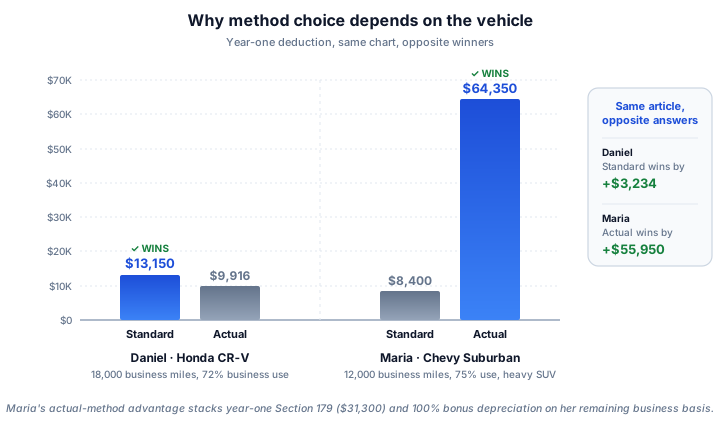
Two contractors buy identical $78,000 SUVs and drive identical 12,000 business miles. One files a year-one vehicle deduction of $8,400. The other files $64,350. The difference is a single decision they made before the year started, and most business owners don't know it exists.
The vehicle deduction is the most-claimed and most-bungled write-off in the small-business tax code. Most people leave money on the table because they pick the wrong method, drive the wrong vehicle for their pattern, or fail to keep the records that defend the number. A few overshoot by counting miles that aren't business miles, which is the quickest way to lose the deduction in audit.
This guide walks you through who can deduct, the two methods (standard mileage versus actual expenses), how to pick between them honestly, the heavy-SUV strategy that gets discussed at every networking event, the records the IRS expects, and how to optimize the deduction year over year. The goal: the largest defensible number, not the largest number on paper.
At a glance
- Two methods: standard mileage rate (a per-mile rate, set annually by the IRS) or actual expenses (real costs × business-use %). Pick the larger one each year, with one important first-year constraint
- First-year rule: if you choose actual expenses and take accelerated depreciation (Section 179 or bonus), you're locked into actual for that vehicle's life
- Records are non-negotiable: a contemporaneous mileage log with date, miles, purpose, and origin/destination per trip. An app makes this five seconds of work per drive
- Entity matters: sole prop / SMLLC deducts on Schedule C. Partners use UPE on Schedule E. S-Corp / C-Corp owners reimburse through an accountable plan
- The heavy SUV strategy is real: vehicles over 6,000 lb GVWR escape the luxury auto cap and qualify for accelerated depreciation, which can produce a large year-one deduction when business use is genuine
The 30-second answer
Read the questions in order. The first one you answer "yes" to tells you the method.
-
Buying a vehicle over 6,000 lb GVWR (gross vehicle weight rating) and using it more than 50% for business? Use the actual method with Section 179 and 100% bonus depreciation. Stop reading and call your CPA before December 31. The year-one deduction can be enormous, and the strategy locks you in for the life of the vehicle.
-
Driving a fuel-efficient car more than ~12,000 business miles per year? Use standard mileage. Track with an app. Move on.
-
First year using a non-heavy vehicle for business, and depreciation plus actual expenses look meaningfully larger than $0.70/mile times your business miles? Run both methods with year-end numbers. Year one is the only year with full method flexibility, so the choice matters more than in any other year.
-
None of the above? Use standard mileage. Lower friction, usually similar or better deduction for ordinary cars. You can switch to actual later if conditions change, with restrictions.
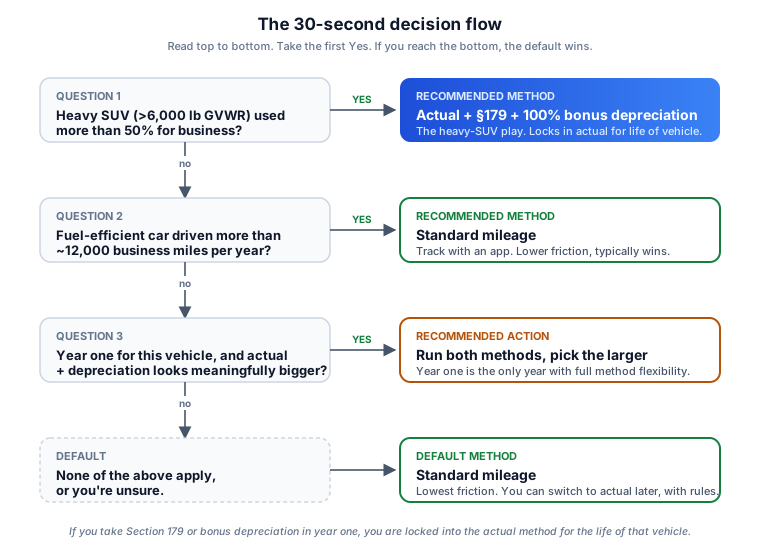
The rest of this guide explains the rules behind those answers, walks two worked examples (a fuel-efficient car and a heavy SUV), and shows the records you'll need to defend whichever method you pick.
Step 1: Are you eligible to deduct?
Before picking a method, confirm you're allowed to deduct at all.
You can deduct directly if you are…
- Self-employed: sole proprietor, single-member LLC, independent contractor, gig worker, freelancer. Deducted on Schedule C
- A partner in a partnership or multi-member LLC where the partnership agreement requires you to pay vehicle expenses without reimbursement. Deducted as an Unreimbursed Partnership Expense (UPE) on Schedule E
You cannot deduct directly if you are…
- A W-2 employee (federal), with three narrow exceptions: armed forces reservists, qualified performing artists, fee-basis state or local government officials
- An S-Corp or C-Corp owner-employee: you receive a W-2 from your own corporation, which puts you in the same bucket as any other employee for this purpose. The right path is to have the corporation reimburse you under an accountable plan, which is functionally a deduction (the reimbursement is tax-free to you and deductible to the corp)
Note: If you operate as an S-Corp and you've been "deducting" mileage by transferring money from the company account to your personal account without an accountable plan in place, you have a problem worth fixing now. Without a written accountable plan and contemporaneous expense reports, the reimbursement can be reclassified as wages, triggering payroll taxes and back-penalties.
Step 2: What counts as a business mile?
A business mile is one driven for an ordinary and necessary business purpose. Examples:
- Driving to meet a client, customer, or prospect
- Driving to a job site, project, or supplier
- Driving between two business locations
- Driving for business errands (bank runs, post office, supply pickup)
- Driving to a temporary work location away from your tax home
- Driving to professional development (a conference, a CE course)
Trips that are not business miles:
- Commuting from your residence to a regular place of business. Even if you drive an hour each way, it's not deductible
- Personal errands mixed into a business trip. If you stop at the grocery store on the way home from a client meeting, that leg is not business
- Charity, medical, or moving miles: these have their own (much lower) per-mile rates and aren't business
The single most valuable angle: if your home qualifies as your principal place of business under the home office rules, trips from your front door to clients become business miles. This is one of the strongest reasons to qualify the home office, separate from the home office deduction itself.
Step 3: Pick a method
Method 1: Standard mileage rate
- The number: a per-mile rate set annually by the IRS. The 2025 business mileage rate is $0.70/mile. Rates update each December for the following year; check the IRS standard mileage page for the current year
- What it covers: gas, oil, maintenance, repairs, insurance, registration, and depreciation. All bundled into the per-mile rate
- What you still deduct separately: parking fees and tolls related to business trips (not subject to the per-mile rate). Interest on a vehicle loan and personal property tax can be deducted in proportion to business use
- Records needed: a contemporaneous mileage log (per-trip), and the total miles driven during the year
- First-year requirement: you must choose standard in the first year you use the vehicle for business. You can switch to actual in a later year, but only if you didn't take Section 179 or bonus depreciation, and you must use straight-line depreciation going forward
- Filed on: Schedule C (if sole prop) with no separate vehicle form. Form 4562 (Part V) is used to report business use
Method 2: Actual expense method
- What you deduct: real expenses × business-use percentage. Expenses include:
- Gas and oil
- Insurance
- Repairs and maintenance
- Tires
- Registration and license fees
- Depreciation (or lease payments)
- Loan interest (proportionate to business use)
- Business-use %: business miles ÷ total miles for the year
- Records needed: every receipt, every bill, the total miles, the business miles, and a depreciation schedule (or lease records)
- First-year flexibility: you can take Section 179 expensing and bonus depreciation in year one, which can produce a very large deduction (especially for heavy vehicles, see Step 5)
- Lock-in: if you take Section 179 or bonus depreciation in year one, you're locked into actual for the life of the vehicle
- Luxury auto cap: regular passenger vehicles are subject to annual depreciation caps. The 2024 first-year cap is $20,400 with bonus, $12,400 without. This caps how fast you can write off an expensive car
- Filed on: Form 4562 for depreciation, Schedule C for the deduction itself
Quick comparison
| Situation | Likely better method |
|---|---|
| Fuel-efficient car, lots of business miles | Standard |
| Older paid-off car, modest expenses | Standard |
| New, expensive passenger vehicle | Actual in year 1 (with depreciation), then re-evaluate |
| Heavy SUV (>6,000 lb GVWR) used >50% for business | Actual with Section 179 (often massive year-1 deduction) |
| Lease | Either works, but standard mileage tends to be simpler |
| Unsure whether to track actual expenses | Standard (lower-friction; the records are easier to keep) |
The right move in most cases: track everything for one full year (mileage and receipts), run both calculations, and pick the bigger number.
Step 4: Calculate it (worked example)
Meet Daniel, a real estate agent operating as a single-member LLC, reporting on Schedule C. He drives a 2023 Honda CR-V (under 6,000 lb GVWR, so a "regular" passenger vehicle).
For the year:
- Total miles driven: 25,000
- Business miles: 18,000 (showings, client meetings, listing visits, supply runs)
- Personal miles: 7,000
- Business-use percentage: 18,000 ÷ 25,000 = 72%
Standard mileage method
Calculation: 18,000 × $0.70 = $12,600
Plus separately deductible: business parking and tolls ($340), business-use share of personal property tax ($210). Total: $13,150.
Actual expense method
| Expense | Annual total | Business-use % | Deductible |
|---|---|---|---|
| Gas | $3,200 | 72% | $2,304 |
| Insurance | $1,800 | 72% | $1,296 |
| Repairs and maintenance | $1,400 | 72% | $1,008 |
| Registration and fees | $300 | 72% | $216 |
| Depreciation (straight-line, year 3 of 5) | $5,500 | 72% | $3,960 |
| Loan interest | $1,100 | 72% | $792 |
| Total | $13,300 | $9,576 |
Plus parking and tolls ($340). Total: $9,916.
Daniel's result: standard mileage wins by ~$3,200. He files standard mileage. This is the typical outcome for fuel-efficient passenger vehicles driven more than ~12,000 business miles a year.
A contrasting example: heavy vehicle, year one
Now meet Maria, a contractor who buys a Chevy Suburban (GVWR 7,300 lbs, well over the 6,000 lb threshold) for $78,000 in March and places it in service immediately. She drives 12,000 business miles and 4,000 personal miles for the rest of the year, for 75% business use.
Standard mileage: 12,000 × $0.70 = $8,400.
Actual expense, with year-one Section 179 and 100% bonus depreciation:
| Step | Calculation | Amount |
|---|---|---|
| Vehicle cost | $78,000 | |
| Business-use basis | $78,000 × 75% | $58,500 |
| Section 179 (capped at SUV limit of $31,300) | min($58,500, $31,300) | $31,300 |
| Remaining business basis | $58,500 − $31,300 | $27,200 |
| Bonus depreciation (100%) | $27,200 × 100% | $27,200 |
| Operating expenses (gas, insurance, repairs, registration) × 75% | ~$7,800 × 75% | $5,850 |
| Year-one total | $64,350 |
Note: The 100% bonus depreciation rate reflects current law. Under TCJA, bonus was scheduled to phase down to 20% in 2026 and 0% in 2027, but the One Big Beautiful Bill Act (OBBBA) signed in July 2025 restored 100% bonus permanently for qualifying property placed in service after January 19, 2025.
Maria's result: actual method, with heavy-vehicle Section 179 and 100% bonus stacking, produces a year-one deduction roughly 7.7× larger than standard mileage. She files actual and is locked into that method for the life of the Suburban. The trade-off: future-year deductions on the vehicle are minimal because she has already written off the entire business basis. The benefit is time-value-of-money (a large deduction now versus a series of smaller ones spread over six years), not extra deduction overall.
Step 5: The heavy SUV strategy (and its limits)
The "heavy SUV deduction" gets hyped at every networking event, often without the caveats. Here's the honest version.
What it is: vehicles with a gross vehicle weight rating (GVWR) over 6,000 pounds are exempt from the IRS's "luxury auto" depreciation caps that limit how fast you can write off a passenger vehicle. Combined with Section 179 expensing and bonus depreciation, this can produce a large year-one deduction.
Note: Why 6,000 pounds? The number isn't arbitrary, and it isn't a tax invention. It's the historical line federal regulators have used to separate "passenger cars" from "light trucks" in fuel-economy (CAFE) and emissions rules going back to the 1970s. When Congress wrote the luxury auto depreciation caps in Section 280F, it carried that engineering boundary into the tax code. Anything heavier was, by federal definition, not a passenger car. The unintended consequence: a lot of family-sized SUVs ended up over 6,000 lb GVWR, which is why the strategy is even available to non-construction businesses today.
Three vehicle classes for tax purposes:
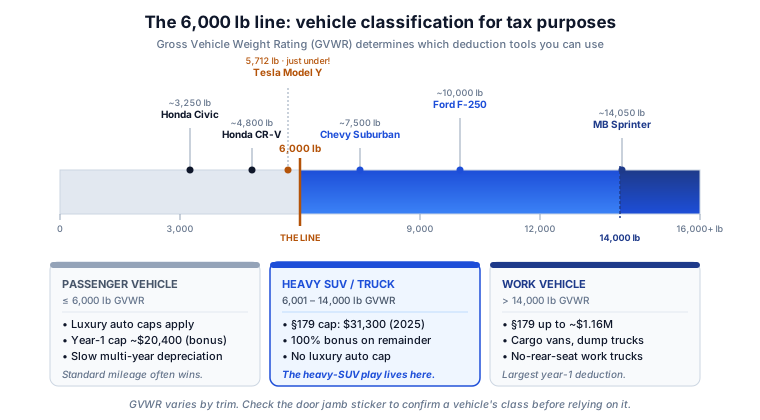
The legitimate use case: contractors, real estate developers, ranchers, trades, anyone who actually needs a large vehicle to do the job. Business use must be over 50% (otherwise Section 179 isn't allowed); records have to prove it.
The traps:
- Personal use sneaks up on you. If business use ever drops below 50% in a future year, you have to recapture prior Section 179 deductions as ordinary income. Buying a $90,000 SUV, deducting most of it in year one, and then driving it mostly personally in year two is exactly the audit-bait scenario the IRS looks for
- State law may not conform. Many states decouple from federal Section 179 / bonus rules. A massive federal deduction can leave you with an unexpected state tax bill
- It's not free. You're trading future depreciation for current depreciation. Over the life of the vehicle, you deduct the same total amount; you've just front-loaded it. The benefit is time-value-of-money, not magic
If the heavy-vehicle strategy fits your business, talk to your CPA before the purchase. The structure of the buy (cash vs. finance vs. lease, December vs. January, business name vs. personal) all affect the size of the year-one deduction.
Step 5.5: Lease vs. buy (and why it matters for your method)
The lease-or-buy decision is usually framed as a financing question. For tax purposes, it also shapes which method is even available to you.
If you buy
- Standard or actual are both available. Pick year one carefully (Section 179 + bonus = lock-in)
- Section 179, bonus depreciation, and the heavy-SUV strategy are available on purchases. Not on leases
- You're depreciating the vehicle over its life. Year one is when you pull the most forward
If you lease
- Standard mileage is available, and choosing it in year one locks you in for the entire lease term (the lease analog of the actual-method depreciation lock-in)
- Actual method for a lease means: (lease payments + operating costs) × business-use %. There's no Section 179 and no bonus depreciation, because you don't own the vehicle
- Lease inclusion amount: for expensive leased vehicles, the IRS publishes an annual table requiring you to add back a small amount to income to neutralize the depreciation advantage of leasing a luxury car. This applies starting at fair market values around $62,000 for 2025. It's a paperwork item, not a deal-breaker, but it exists
Which is better for the deduction?
It depends on the vehicle and your time horizon.
- Heavy SUV used genuinely in business, kept 5+ years: buying wins because Section 179 + bonus produces a much larger early-year deduction
- Regular passenger vehicle, kept 3 years or less: leasing often wins because lease payments roughly track the depreciation portion you'd be entitled to anyway, with less paperwork
- Cash-flow-constrained business: leasing reduces the upfront cost and gives a steadier (smaller) annual deduction. The tax savings of buying-and-179'ing only matter if you actually have the cash to buy
The lease-vs-buy question deserves more than a tax answer alone. Insurance cost, mileage limits in the lease, expected resale value, and your business's growth all matter. But knowing that buying unlocks the heavy-SUV play and leasing doesn't is often the deciding factor for contractors and trades.
Step 6: Records the IRS expects
Mileage records are where most deductions die in audit. The standard is contemporaneous, meaning recorded at or near the time of the event.
What a compliant mileage log shows for each business trip
- Date of the trip
- Origin and destination
- Business purpose (e.g., "client meeting with Acme," "showing 742 Elm")
- Miles driven
What additionally to keep
- Total miles for the year: an odometer reading on January 1 and December 31, ideally photographed
- Vehicle ownership/lease records: title, registration, insurance card
- If actual method: every gas receipt, every repair bill, every insurance statement, every lease invoice, the depreciation schedule
- If S-Corp accountable plan: monthly expense reports the corporation reimbursed against, plus the policy itself
How long to keep them
At least three years past the return's due date (the standard audit window). If you took depreciation, keep the depreciation schedule for the life of the vehicle plus three years, because depreciation recapture math depends on it.
The fastest workflow
Use an app. MileIQ, Stride, Everlance, or your accounting tool's built-in mileage feature can automatically detect drives via GPS and let you swipe each one as business or personal. The contemporaneous-log requirement turns from a year-end nightmare into a five-second daily decision.
Note: Reconstructing a mileage log from memory at tax time is the #1 reason mileage deductions are disallowed in audit. The number itself might be approximately correct; the records aren't, and the IRS can disallow the entire deduction even if your intent was honest. Track contemporaneously. The friction with an app is essentially zero.
Note: Already mid-year and didn't track? You haven't lost the deduction. Three things to do today: (1) install a mileage app and start logging now, contemporaneously, for the rest of the year; (2) reconstruct the most defensible record you can for the year-to-date portion using calendar entries, client meeting confirmations, email timestamps, and credit-card location data, clearly labeled as a reconstruction; (3) photograph your current odometer so you can establish year-end total miles. The reconstructed portion is weaker than contemporaneous records and could be challenged in audit, but it's far better than skipping the deduction or making the number up. Going forward, you'll have the contemporaneous record the IRS expects.
Step 7: Optimize the deduction over time
A few habits separate the people who maximize this deduction from the people who don't.
1. Run both calculations every year
Even if you used standard last year, recompute actual this year using actual records. Pricing of gas, insurance, and repairs shifts; the IRS rate shifts; the math changes. Don't autopilot.
2. Treat year one as the strategic year
The first year you place a vehicle in service is the only year with full method flexibility. That's when you decide: take Section 179 / bonus and lock into actual, or stay standard for the life of the vehicle. Run scenarios before the year ends; once the year closes, half the doors are shut.
3. Time the purchase
If you're going to buy a heavy vehicle and stack Section 179 + bonus depreciation, place it in service before December 31 of the year you want the deduction. "In service" means available for business use, not just delivered. A truck sitting in your driveway with plates on it counts; one still on the dealer lot does not.
4. Qualify the home office
If your home qualifies under the home office rules, every drive from your home to a business destination is a business mile. Many small business owners leave thousands in mileage on the table because their home doesn't qualify and the first leg of every trip is non-deductible commuting.
5. Keep personal use honest
The fastest way to torch a Section 179 deduction is to let business use drift below 50% in a later year. If you took the deduction, use the vehicle for business. If business use is going to drop, plan for the recapture in advance.
6. For S-Corp owners, reimburse at the IRS rate
The cleanest setup: the corporation pays you a per-mile reimbursement at the current IRS standard rate, against monthly expense reports. The reimbursement is tax-free to you and a deduction to the corp. No need to track the corp-owned-vehicle complications. This is the path most S-Corp owners should default to.
7. Multiple vehicles, multiple methods
If you have two vehicles used for business (e.g., a fuel-efficient sedan for client meetings and a heavy SUV for hauling supplies), you can pick a different method for each. Each vehicle's method is independent. Run the math separately and pick what's optimal per vehicle.
Quick-decision checklist
Before you file, run through this:
- I'm self-employed, a partner, or an S-Corp owner using an accountable plan (not a regular W-2 employee)
- I have a contemporaneous mileage log for every business trip
- I have odometer readings from start and end of year
- I've separated business miles from commuting miles (and I know whether my home office qualifies)
- I've calculated both standard mileage and actual expenses, and picked the larger
- If I took Section 179 or bonus depreciation in year one, I understand I'm locked into actual
- If I'm using the actual method, I have receipts and the depreciation schedule
- My business-use percentage is documented and defensible
Common mistakes that get the deduction disallowed
- Reconstructing the mileage log at tax time. Even an accurate number can be disallowed if the records aren't contemporaneous
- Counting commuting as business miles (without a qualifying home office)
- Taking 100% business use when there's any personal use. Even small amounts of personal use require a percentage allocation. The IRS knows nobody owns a vehicle they don't drive personally at all
- Mixing methods within a year for the same vehicle. You pick one method per vehicle per year
- Switching from actual to standard after taking accelerated depreciation. Once you've taken Section 179 or bonus, you're locked in
- Forgetting the personal-use add-back for company-owned vehicles. If the corporation owns the vehicle and you use it personally, the personal use is taxable W-2 income to you
- Buying a heavy SUV and dropping below 50% business use in year two. This triggers Section 179 recapture as ordinary income
References
- IRS Publication 463: Travel, Gift, and Car Expenses: the canonical rules
- IRS Standard Mileage Rates: updated each December for the following year
- Form 4562: Depreciation and Amortization: used for Section 179, bonus, and depreciation
- Schedule C: Profit or Loss from Business: where the deduction lands for self-employed taxpayers
- Topic No. 510, Business Use of Car: a useful summary
Key takeaway
The vehicle deduction rewards three habits. First, track every mile contemporaneously, with an app that makes it five seconds of work per drive. Second, run both methods every year and pick the larger number, knowing year one is the strategic year because some choices lock in for the vehicle's life. Third, match the vehicle to the strategy: a fuel-efficient car driven a lot of business miles is a standard-mileage situation; a heavy SUV used genuinely in business is an actual-method-with-Section-179 situation.
Done well, the vehicle deduction is one of the largest line items on a self-employed return. Done sloppily, it's the one most likely to disappear in audit. The difference is the records, not the math.
Related
- The home office deduction: qualifying turns front-door-to-client driving into deductible business miles, often the single biggest unlock for self-employed mileage
- Accountable plans: the only correct way for S-Corp and C-Corp owners to deduct business mileage. Reimbursement is tax-free to you and a deduction to the corporation
Disclaimer
This guide explains federal vehicle and mileage deduction rules at a high level. It is not tax, legal, or financial advice. Eligibility, mileage rates, Section 179 limits, bonus depreciation, luxury auto caps, and state treatment vary by jurisdiction and individual circumstance. Tax laws change. The Tax Cuts and Jobs Act provisions referenced above were made permanent by the One Big Beautiful Bill Act in July 2025, including the restoration of 100% bonus depreciation for qualifying property placed in service after January 19, 2025. Section 179 limits, the standard mileage rate, and state-level treatment continue to evolve year over year. Consult your CPA or tax advisor for guidance specific to your situation.
Try it in Twin Owls
See this in action in the app. Open in app