
The Twice-Monthly Rhythm
How to maintain the Profit First system with a consistent allocation cadence, protect owner compensation, and use your financial reports to stay on track.
6 min readPublished March 22, 2026 · Updated April 18, 2026
Accounts and allocations are the setup. The rhythm is what makes the system stick — the twice-monthly cadence that turns Profit First from a one-time configuration into a permanent operating habit.
Rhythm and consistency over precision
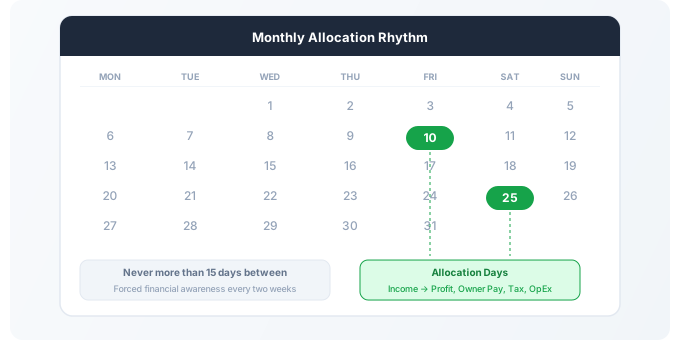
The system does not require perfect percentages or ideal financial conditions to begin. It requires consistent behavior: distributing from the Income account on the 10th and 25th, moving funds according to pre-set allocations, and — critically — never raiding the Profit or Tax accounts to cover operational shortfalls.
Why twice a month?
The twice-monthly allocation rhythm serves as a forcing function for financial awareness. Many business owners go weeks without looking at their cash position. The 10th-and-25th discipline means no owner goes more than two weeks without a clear, account-by-account picture of where the business stands.
This cadence also aligns with typical business payment cycles. Most bills are due monthly, payroll runs on a semi-monthly or biweekly schedule, and revenue arrives in uneven intervals. Allocating twice a month smooths these rhythms and prevents the feast-or-famine cash flow pattern that leads to poor spending decisions.
The allocation day checklist
On each allocation day, the process is the same:
- Check the Income account balance — this is the total revenue received since the last allocation
- Calculate each allocation — multiply the balance by your current percentages (CAPs)
- Transfer to each account — move the calculated amounts from Income to Profit, Owner Pay, Tax, and OpEx
- Verify Income returns to zero — nothing should remain in the holding account
- Pay bills from OpEx only — if OpEx is insufficient, expenses must be cut, not covered from other accounts
Note: The hardest rule to follow is never raiding the Profit or Tax accounts. When OpEx runs short, the instinct is to borrow from elsewhere. Resist it. That shortfall is a signal that your expenses are too high — not that your allocations are wrong.
What imperfect looks like (and why it works)
Michalowicz is explicit: the power of Profit First lies not in financial sophistication but in behavioral simplicity. The accounts are the system. The rhythm is the discipline. Imperfect percentages executed consistently will produce better outcomes than a theoretically perfect system that gets ignored.
If you miss an allocation date, do it the next day. If your percentages aren't ideal, adjust them next quarter. If your first profit distribution is $47, celebrate it. The system compounds — both financially and behaviorally — and the early imperfections are the price of getting started.
The business must sustain the owner
A recurring theme throughout the Profit First framework is that many business owners inadvertently become the lowest-paid — or entirely unpaid — employees of their own companies. They defer their compensation indefinitely in service of "the business," often rationalizing it as investment or patience.
The Owner Pay account exists to break this pattern permanently. Paying yourself a consistent salary from a dedicated account separates your personal financial health from the volatility of the business.
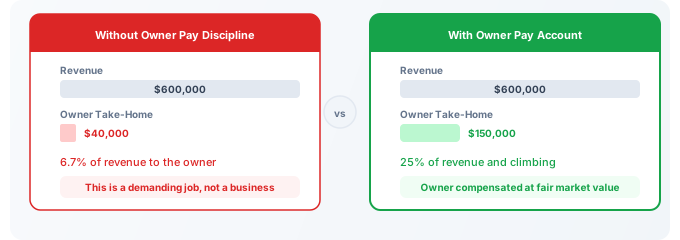
It also reveals something important: if the business cannot sustain the owner's fair market salary at its current revenue, it is not yet a viable business — regardless of how impressive the top line looks.
Benchmarking owner compensation
Ask yourself: if you hired someone to do everything you do for the business, what would you pay them? Look at comparable job postings for your role — operations manager, general contractor, bookkeeper, marketing director — and use the median salary in your market as the benchmark. That number is what your Owner Pay allocation should be moving toward over time.
If the gap between your current Owner Pay and the benchmark feels impossibly wide, that's useful information. It means the business in its current form cannot support a fairly compensated operator — and the system is surfacing that truth now rather than letting it compound for years. The quarterly CAP increases from Part 2 close this gap gradually.
How Twin Owls helps
Tracking allocations over time
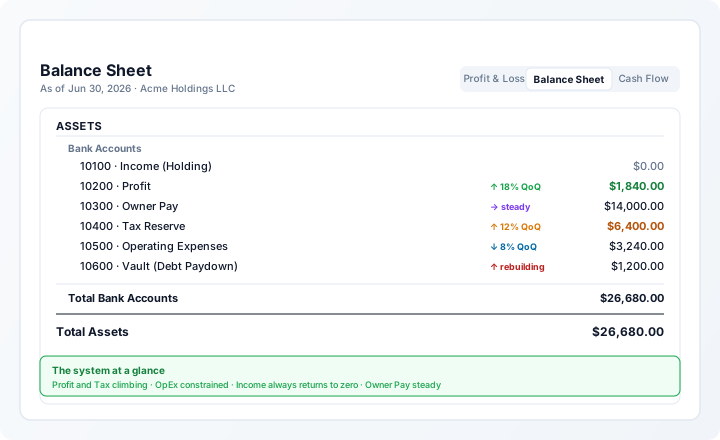
Each allocation you record as a journal entry creates a data point in your financial history. If you set up templates in Part 2, each allocation day takes less than five minutes — open the template, adjust amounts, and post. Over time, your reports reveal patterns:
- Balance sheet — shows the balance of each Profit First account at any point in time. Are your Profit and Tax accounts growing? Is Owner Pay consistent? Is OpEx trending down as planned?
- Income statement — reveals whether the business is generating enough revenue to support the allocation percentages you've chosen
- Cash flow statement — confirms that the allocation transfers actually happened and that OpEx spending stayed within its constraint
Multi-entity isolation
If you manage multiple businesses through Twin Owls, each entity gets its own set of Profit First accounts. A rental property LLC might have very different TAPs than a consulting practice. The multi-entity switcher keeps each system isolated while giving you a bird's-eye view across entities.
Common pitfalls
The system is simple, but three failure patterns come up repeatedly:
Setting CAPs too aggressively. Jumping to a 10% profit allocation when you've never saved a dollar feels ambitious. It also fails fast — within a month, OpEx runs short, the owner raids the Profit account, and the whole system feels broken. Start at 1%. The system is designed to ratchet up over quarters, not shock the business into compliance.
Raiding Profit or Tax to cover expenses. This is the single most common way the system collapses. When OpEx runs short, the instinct is to "borrow" from another account temporarily. But there is no temporary — once the boundary is crossed, every future shortfall becomes an excuse to cross it again. If OpEx is consistently insufficient, the answer is to cut expenses or adjust CAPs at the quarterly review, not to quietly dismantle the account separation that makes the system work.
Skipping allocation days. Missing the 10th or 25th once is fine — do it the next day. Missing it repeatedly destroys the rhythm, and without the rhythm there is no system. Revenue accumulates in the Income account, the owner starts paying bills from it directly, and within a few weeks the business is back to a single-account model. The fix is to treat allocation day like payroll — it happens on schedule regardless of how busy the week is.
Putting it all together
The Profit First framework across all three parts of this series reduces to a simple loop:
- Revenue arrives — it enters the Income account
- Allocate on the 10th and 25th — split by your current percentages into Profit, Owner Pay, Tax, OpEx (and Vault if you carry debt)
- Pay bills from OpEx only — the constraint forces expense discipline
- Distribute profit quarterly — 50% as a reward, 50% as a reserve
- Increase allocations by 1–3% each quarter — move toward your TAPs gradually
- Repeat — the rhythm compounds, the allocations improve, and the business becomes structurally profitable
Your first week
The practical entry point is simpler than most people expect. Here's what to do this week:
- Open your bank accounts — at minimum, a Profit account separate from your operating account. Ideally all five (Income, Profit, Owner Pay, Tax, OpEx). Many banks offer free sub-accounts.
- Set up the accounts in Twin Owls — add them to your chart of accounts using the codes from Part 2 (10100–10600).
- Pick your starting CAPs — even 1% to Profit, 35% to Owner Pay, 10% to Tax, and 54% to OpEx. Check the revenue-band TAP table to know where you're headed.
- Mark the 10th and 25th on your calendar — set a recurring reminder. These are your allocation days.
- On the next allocation day, make your first transfers — record them as journal entries in Twin Owls and save each one as a template.
That first Profit account — untouched, accumulating — is the beginning of the system. Everything else follows from the habit of protecting that number first.
Frequently asked questions
What if my business has seasonal revenue? The system still works — you're allocating percentages, not fixed dollar amounts. In a strong month, more goes into each account. In a lean month, less goes in, but the proportions hold. The key is maintaining the rhythm even when the amounts feel small.
How long does it take to reach TAP allocations? Most businesses reach their Target Allocation Percentages within 6 to 10 quarters (roughly 2 to 2.5 years), depending on how aggressively expenses can be cut and revenue grown. The important thing is directional progress each quarter.
Should the owner take a salary even when the business is struggling? Yes — even if it's a reduced amount. The Owner Pay account ensures the owner is compensated for their labor. If the business cannot pay the owner at all, that is critical information about the business's viability, not a reason to work for free.
Can I automate the allocations? Some banks allow automatic percentage-based transfers. If yours does, set them up for the 10th and 25th. Otherwise, the manual process takes five minutes with journal entry templates — and the forced engagement with your numbers is actually part of the benefit.
Related
- Part 1: The Framework — the flipped formula and five-account system
- Part 2: Setting Up Your Allocations — CAPs, TAPs, and profit distribution
- Accounting basics — the equation behind every journal entry
- Journal entries explained — recording the twice-monthly allocations
This article is an independent educational summary of concepts from Profit First by Mike Michalowicz. Twin Owls is not affiliated with, sponsored by, or endorsed by the author or publisher, and this series is not an endorsement of the Profit First system. It does not constitute financial or accounting advice. Consult a qualified accountant or CPA for guidance specific to your situation.
Series complete
You've finished the Profit First series
Put it into practice in Twin Owls, or revisit any part from the series overview.