
Setting Up Your Allocations
How to determine your Current and Target Allocation Percentages, distribute quarterly profit, and eliminate business debt using the Profit First system.
6 min readPublished February 21, 2026 · Updated April 17, 2026
With the framework in place, the next step is translating it into specific percentages — how much goes where, how you evolve those numbers over time, and what to do with accumulated profit and business debt.
Start where you are: CAPs and TAPs
Most businesses cannot jump to ideal profit allocations on day one. The system distinguishes between two sets of percentages:
- Target Allocation Percentages (TAPs) — where you want to be in two to three years
- Current Allocation Percentages (CAPs) — where you genuinely are today
Typical TAP targets for a mature small business look something like this:
| Account | Target | Role |
|---|---|---|
| Profit | 5% | The floor, not the ceiling — grows as efficiency improves |
| Owner Pay | 50% | Fair market value for the owner's labor |
| Tax | 15% | Reserved proactively, not scrambled for at quarter-end |
| OpEx | 30% | What remains to run the business |
Note: These percentages vary significantly by revenue level and business model. The table above shows targets for a mature small business. Michalowicz provides different ranges depending on annual revenue — use the band closest to yours as a starting reference, not a universal prescription.
TAP ranges by revenue band
| Annual Revenue | Profit | Owner Pay | Tax | OpEx |
|---|---|---|---|---|
| $0–250K | 5% | 50% | 15% | 30% |
| $250K–500K | 10% | 35% | 15% | 40% |
| $500K–1M | 15% | 20% | 15% | 50% |
| $1M–5M | 10–15% | 10–15% | 15% | 55–65% |
| $5M+ | 10–20% | 5–10% | 15% | 55–65% |
As revenue grows, the Owner Pay percentage drops because the dollar amount stays large even at a smaller slice. A $2M business at 10% Owner Pay still pays the owner $200,000. Meanwhile, profit and operating expense percentages shift to reflect the operational complexity of larger businesses. Find your band, use it as your TAP target, and adjust based on your specific industry and cost structure.
The key insight is that what matters is the direction of travel. Start with a CAP of even 1% to profit and increase each allocation by 1–3% every quarter. Over two to three years, most businesses converge on their TAPs without catastrophic disruption to operations.
A quarterly progression
Here's what a gradual CAP-to-TAP transition might look like for a business currently spending almost everything on operations:
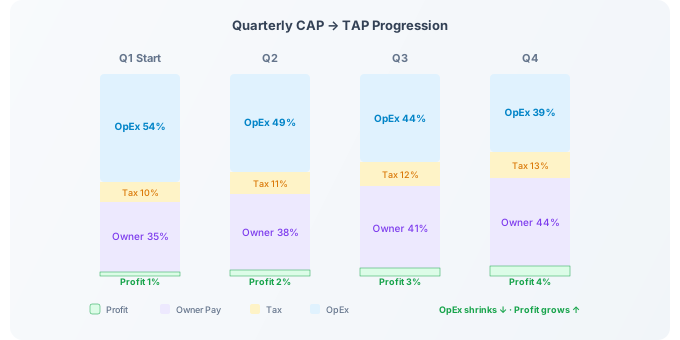
Here are the exact allocations at each quarter:
| Profit | Owner Pay | Tax | OpEx | |
|---|---|---|---|---|
| Q1 (start) | 1% | 35% | 10% | 54% |
| Q2 | 2% | 38% | 11% | 49% |
| Q3 | 3% | 41% | 12% | 44% |
| Q4 | 4% | 44% | 13% | 39% |
| Target (TAP) | 5% | 50% | 15% | 30% |
Each quarter, OpEx absorbs the squeeze. The constraint forces the expense audit described in Part 1 — subscriptions get canceled, vendors get renegotiated, and the business discovers how much of its spending was habit rather than necessity.
Profit is a reward, not a reinvestment fund
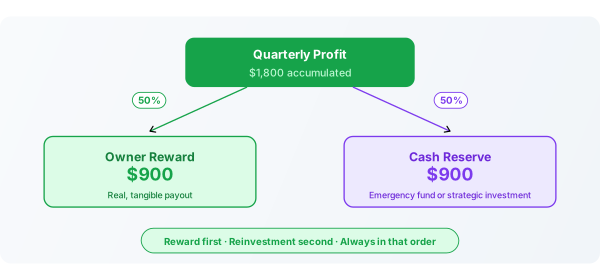
One of the most counterintuitive prescriptions in the book: when quarterly profit accumulates, distribute half of it to yourself as a tangible reward. Do not reinvest it automatically back into the business.
This serves two purposes. First, it makes the payoff of running a business real and felt — something the owner experiences rather than watches flow back into the machine. Second, it prevents the common trap of perpetual "reinvestment" that leaves owners working for years without seeing personal financial benefit.
Worked example
Say your business brings in $20,000 per month — $60,000 over a quarter. At a 3% profit allocation, that puts $1,800 in your Profit account. On distribution day:
- $900 goes to the owner as a reward — dinner, a vacation fund, whatever makes the work feel worth it
- $900 stays in the business as a cash reserve or strategic investment fund
The remaining half can be deployed for capital purchases, emergency reserves, or growth investments — but the sequence is fixed: reward comes before reinvestment. If profit never feels like profit, there is no behavioral reinforcement to protect and grow it.
Eliminate debt with a Vault account
For businesses carrying debt, Michalowicz recommends adding a sixth account: a Vault. This is a dedicated savings vehicle funded by a small but consistent allocation from every deposit — even 1% to start.
Over time, the Vault accumulates capital that is then deployed in lump sums to eliminate debt, beginning with the smallest balance first. This is the business equivalent of the personal finance debt snowball: small wins build momentum, each eliminated obligation frees up cash flow, and the psychological burden of debt is replaced by the mechanical satisfaction of a shrinking list.
The key insight is structural, not motivational. Businesses that try to pay down debt "when there's extra cash" rarely succeed, because extra cash rarely exists. Treating debt repayment as a non-negotiable allocation removes it from the realm of intention and puts it on the same mechanical footing as payroll.
Setting up the Vault allocation
When debt exists, the allocation table gets a sixth row:
| Account | Allocation |
|---|---|
| Profit | 1% |
| Owner Pay | 35% |
| Tax | 10% |
| Vault (debt) | 3% |
| OpEx | 51% |
As each debt is eliminated, the freed cash flow can be redirected — either into accelerating the next debt payoff or into increasing the Profit and Owner Pay allocations toward their TAPs.
How Twin Owls helps
Setting up your Profit First accounts
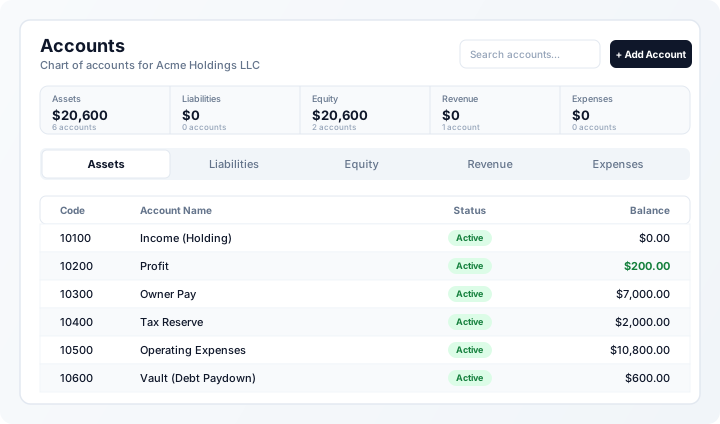
In your chart of accounts, create each Profit First account as a bank or asset account under the Assets section. A clean setup might look like this:
| Code | Account Name | Type |
|---|---|---|
| 10100 | Income (Holding) | Bank |
| 10200 | Profit | Bank |
| 10300 | Owner Pay | Bank |
| 10400 | Tax Reserve | Bank |
| 10500 | Operating Expenses | Bank |
| 10600 | Vault (Debt Paydown) | Bank |
Recording allocations as journal entries
On the 10th and 25th, record each allocation as a journal entry. For example, moving $200 to Profit from Income (1% of a $20,000 deposit):
| Account | Debit | Credit |
|---|---|---|
| Profit (10200) | $200 | |
| Income Holding (10100) | $200 |
Repeat for Owner Pay, Tax, and OpEx. Each transfer is its own entry for a clean audit trail.
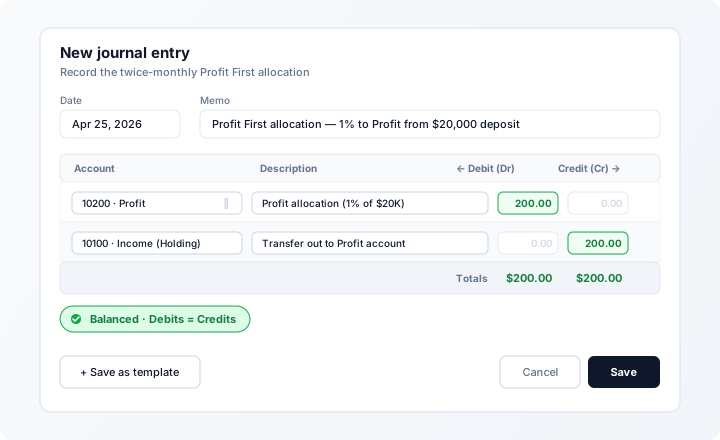
Note: Use Save as template on your first set of allocation entries. On future allocation days, create from the template and adjust the amounts — the accounts stay the same every time.
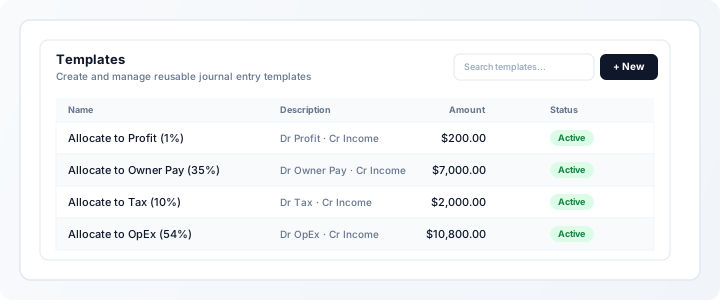
Recording the quarterly profit distribution
When you distribute quarterly profit, the owner draw entry records the reward half leaving the business:
| Account | Debit | Credit |
|---|---|---|
| Owner's Draw | $900 | |
| Profit (10200) | $900 |
The remaining $900 can be transferred to a separate reserve account or left in the Profit account until it's deployed for a strategic investment.
Key takeaway
The path from where you are to where you want to be is paved with small, consistent adjustments — not dramatic overhauls. Start with a 1% profit allocation, increase by 1–3% each quarter, and let the constraint do the work of identifying unnecessary expenses. Distribute half your accumulated profit as a real reward, and treat debt like any other non-negotiable allocation.
Part 3: The Twice-Monthly Rhythm covers how to maintain this system as an ongoing habit and ensure the business sustains its owner.
Frequently asked questions
How do I know what my current allocation percentages are? Look at your last three months of financials. Add up total revenue, total owner compensation, total tax payments, and total operating expenses. Divide each by total revenue to get your CAPs. The gap between those numbers and your TAPs tells you how far you need to travel.
What if I can't afford to increase allocations by even 1% this quarter? Then hold steady and focus on cutting expenses. The constraint from your current allocation should surface costs that can be eliminated. Once you've freed up even a small amount of cash flow, redirect it to the next allocation increase.
Related
- Part 1: The Framework — the flipped formula and five-account system
- Part 3: The Twice-Monthly Rhythm — sustaining the system
- Journal entries explained — recording allocations and distributions
- Setting up your chart of accounts — creating Profit First accounts in your ledger
This article is an independent educational summary of concepts from Profit First by Mike Michalowicz. Twin Owls is not affiliated with, sponsored by, or endorsed by the author or publisher, and this series is not an endorsement of the Profit First system. It does not constitute financial or accounting advice. Consult a qualified accountant or CPA for guidance specific to your situation.