
The Framework That Flips Business Finance
Why Revenue minus Profit equals Expenses works better than the traditional formula — the multi-account system and behavioral economics behind Profit First.
6 min readPublished January 25, 2026 · Updated April 16, 2026
You made $400,000 in revenue last year. Your business is growing. And yet, somehow, you have less than $3,000 in your checking account, a tax bill you can't pay, and you haven't given yourself a raise in two years.
This is the paradox that Profit First was written to solve. Most small businesses don't fail because they lack revenue. They fail because revenue disappears into expenses before profit ever gets a chance to form. Mike Michalowicz's framework — first published in 2014 and expanded in 2017 — doesn't fix this with better accounting. It fixes it by changing the behavior that accounting enables.
The core insight is drawn from behavioral economics: we spend what is available. Every dollar sitting in a single operating account is a dollar at risk of being consumed. The solution isn't discipline — it's architecture. By restructuring how money flows through a business from the moment it arrives, owners stop hoping for profit at the end of the month and start guaranteeing it at the beginning.
Flip the formula
Traditional accounting teaches: Revenue - Expenses = Profit. Under this model, profit is a residual — something that appears (if you're lucky) after every obligation has been met. The result? Profit almost never appears, because expenses reliably expand to consume whatever cash is available.
Michalowicz inverts this: Revenue - Profit = Expenses. The moment money enters the business, a predetermined slice is set aside as profit. Only what remains is available for operations. This forces the business to live within its actual means rather than its theoretical ones.
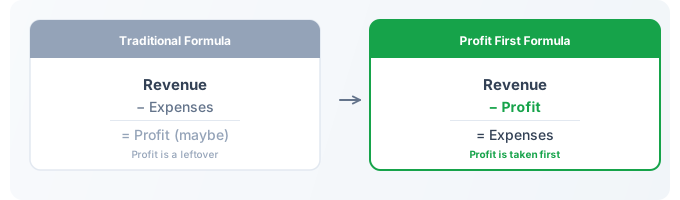
This isn't merely a mindset shift — it's a structural one. The formula only works when it is enforced mechanically through separate bank accounts, not through willpower or spreadsheets. Knowing you should save profit is useless. Making it structurally impossible to spend it is the point.
The five-account system
The operational heart of Profit First is a multi-account banking system. Rather than running all money through a single checking account, owners open five core accounts and allocate every deposit across them according to predetermined percentages.
| Account | Role | Purpose |
|---|---|---|
| Income | Holding Account | All revenue lands here first. Allocations flow out on a set schedule. |
| Profit | Profit Account | Reserved and untouched. Distributed quarterly as an owner reward. |
| Owner Pay | Owner's Comp | Ensures the owner pays themselves a regular, sustainable salary. |
| Tax | Tax Account | Funds reserved so tax obligations are never a surprise. |
| OpEx | Operating Expenses | The only account used to pay bills. If it's empty, spending stops. |
A worked example. Say your business brings in $20,000 in a month. Using conservative starting allocations, the deposit into your Income account immediately gets split:
- $200 (1%) moves to Profit
- $7,000 (35%) to Owner Pay
- $2,000 (10%) to Tax
- $10,800 (54%) to OpEx
The Income account returns to zero. Every bill, vendor, and subscription must be paid from that $10,800 — nothing else. These are intentionally conservative starting percentages — Part 2 explains how to increase them each quarter toward your long-term targets.
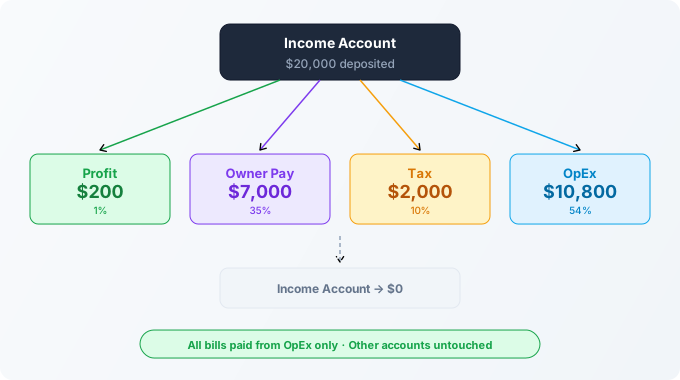
Allocations happen twice a month, typically on the 10th and 25th. This regular cadence removes the temptation to delay and creates a predictable financial rhythm the business can be managed around.
Small plates: Parkinson's Law applied to cash
Parkinson's Law states that work expands to fill the time available. Michalowicz applies the same principle to money: expenses expand to consume whatever cash is available. A larger operating account doesn't produce savings — it produces larger costs.
By deliberately constraining the OpEx account, owners are forced into creativity, prioritization, and hard choices about what the business actually needs versus what it merely accumulates. The "small plate" metaphor is intentional: when you eat from a smaller plate, you naturally eat less without consciously rationing every bite. The same psychology governs business spending.
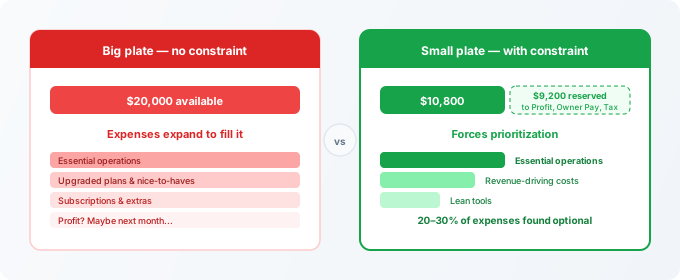
This is why the system works even when — especially when — the percentages feel uncomfortably tight. The discomfort is the mechanism. It compels owners to audit every recurring expense, cancel what doesn't directly drive revenue, and find leaner ways to operate. Many business owners discover, once constrained, that 20–30% of their monthly expenses were optional.
There's a deeper reason the multi-account structure works: most business owners don't manage their finances by reading reports — they manage by glancing at their bank balance. If the checking account looks healthy, they spend freely. If it looks low, they panic. Michalowicz calls this "bank balance accounting," and rather than fighting it, Profit First uses it. When you look at your OpEx account and see $10,800 instead of $20,000, you make different decisions. The constraint is visible at the moment it matters most — when you're about to spend.
How Twin Owls helps
Twin Owls's chart of accounts and multi-entity ledger map naturally to the Profit First account structure. You can set up each of the five Profit First accounts as separate bank or asset accounts in your chart of accounts — Income, Profit, Owner Pay, Tax, and OpEx — and track balances independently.
When allocation day arrives, you record each transfer as a journal entry — debit the destination account, credit Income. Your balance sheet then shows the real-time balance of each Profit First account, and your reports reflect exactly where the money went. Part 2 walks through the full setup: account codes, journal entry examples, and how to save templates so the process takes less than five minutes.
Key takeaway
Profit First works not because it is complex, but because it is structural. The formula flip removes profit from the "whatever is left over" category. The five-account system makes allocations visible and enforceable. And the small-plate constraint turns behavioral psychology from an enemy into an ally.
The framework doesn't require perfect numbers on day one — just the willingness to separate money before spending it. Part 2 covers how to set your starting percentages and evolve them over time.
Frequently asked questions
Do I need five separate bank accounts? Ideally, yes. The behavioral power of the system comes from physical separation. When the Profit account is a real, visible account with a real balance, it's much harder to raid than a number on a spreadsheet. Some banks offer free sub-accounts that make this easy.
What if my business can't afford to set aside profit yet? Start with 1%. Even on $10,000 in monthly revenue, that's $100. The amount isn't the point — the habit is. Part 2 explains how to increase your allocations gradually using CAPs and TAPs.
How does this relate to double-entry bookkeeping? Profit First is a cash management framework, not a replacement for double-entry accounting. The two work together: double-entry bookkeeping records what happened accurately, while Profit First determines how cash is allocated before it gets spent.
Related
- Setting up your chart of accounts — create the accounts your Profit First allocations flow through
- Journal entries explained — how to record the twice-monthly allocations
- Single entry vs. double entry — why the underlying bookkeeping method matters
This article is an independent educational summary of concepts from Profit First by Mike Michalowicz. Twin Owls is not affiliated with, sponsored by, or endorsed by the author or publisher, and this series is not an endorsement of the Profit First system. It does not constitute financial or accounting advice. Consult a qualified accountant or CPA for guidance specific to your situation.